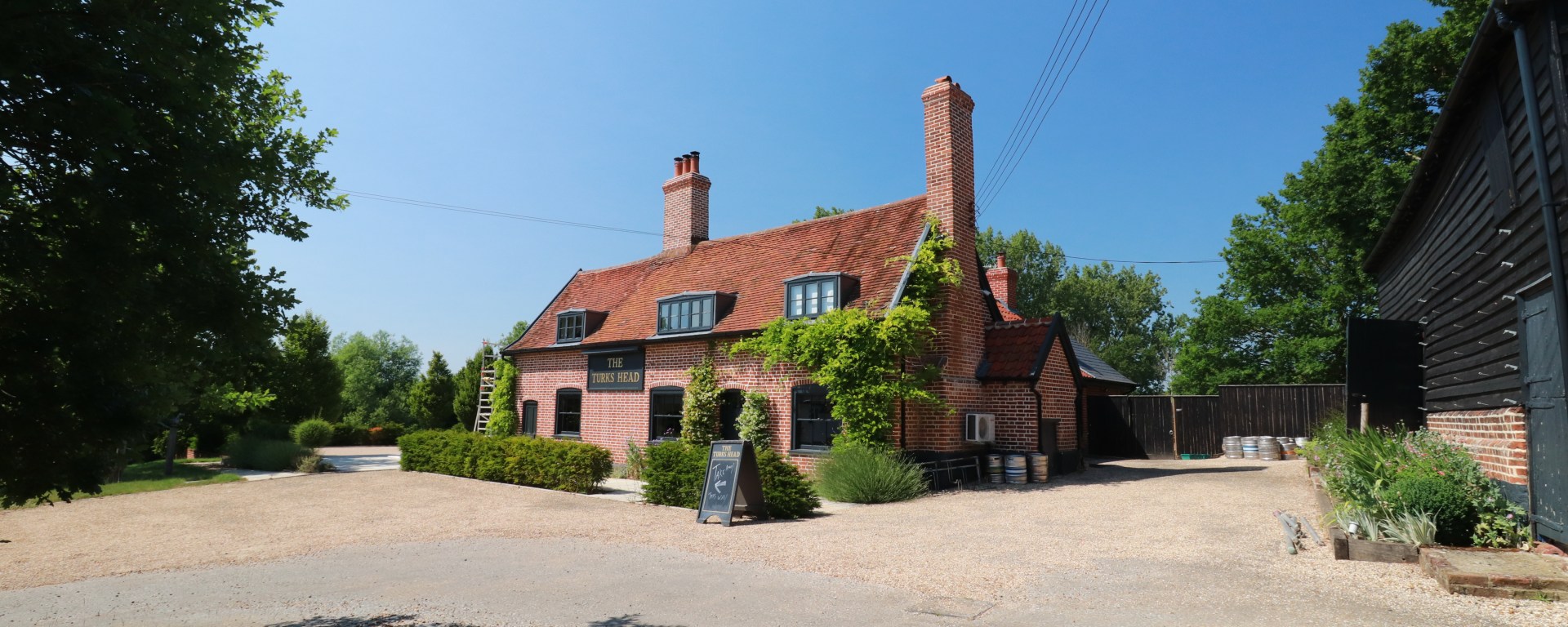
Please note this is NOT the official Turk’s Head website. For more information, events, opening hours and booking, see the Turk’s Head website.
This page focuses on the history of the Hasketon Turk’s Head, a history going back to at least 1756, and almost certainly much earlier. There are a few gaps, but I hope the following provides some interesting background to the journey of a simple village pub through the ages.
The Name
The Pubs Galore website maintains a list of the most common pub names in the UK. At the top of the list are the loyalist and patriotic names such as the ‘Red Lion’ (555), the Crown (501) and the Royal Oak (428). In order to find the Turk’s Head you have to scroll down to number 198, with a score of 23. (Now there’s an interesting project – visit them all!)
The name “Turk’s Head”, along with the similar “Saracen’s Head”, is generally thought to be a reference either to the Crusades against the Holy Land (1096-1271), or to the North African based Barbary Pirates. The latter were much feared during the 16th and 17th centuries and were a major threat to shipping and coastal communities in the Mediterranean Sea and up the Atlantic coastal communities as far as Iceland. Typically, their captives, and some estimates suggest there were over a million of them, were sold into the Ottoman and Arabic slave markets, hence the Turkish connection. There’s no evidence they got as far as Hasketon, and the Crusades were a long time ago, so at the moment, quite why the pub has it’s name is unclear.
Of course, the term ‘Turk’s Head’ has been used in several other contexts. It is, for example, a name given to a rather complex knot. You can learn how to tie one here: https://www.animatedknots.com/turks-head-knot. In fact, The previous landlady, Jemima, once told me there’s a possibility this may be how our Turk’s Head got it’s name, perhaps connected to a rope making history. I was a little skeptical about this when she first mentioned it to me, but this was a rope making area (e.g. Rope Walk in Ipswich), and back in Victorian times a nearby field was described as a ‘Hemp Field’ in its sales particulars, so there may be something in this after all.
There’s also a 19th century cavalry game called ‘Cutting the Turk’s Head (off)’, which seemed to involve slicing in half a cabbage, or similar object atop a pole, with a sabre, as you gallop past. This extract describes a military show at the Essex Agricultural Exhibition:
‘The military competitions on Thursday afternoon were pretty much of the same character as on the preceding day, with the exception of the wrestling on horseback, for which was substituted what is known as “Cutting the Turk’s head off”. The three guns which competed on Wednesday repeated their performance of riding through hurdles, the Colchester Battery again carrying off the palm. A fairly good exhibition of swordsman- ship was then witnessed by several Non-commissioned Officers of the 7th Hussars, in ” Cutting the Turk’s head off,” viz., Sergeant-Majors Hayward, Murray, Chester, and Ryan ; Sergeants Duncan and King, and Corporal Eraser. The first prize was awarded to Sergeant King, the second to Sergeant-Major Chester, and the third to Corporal Eraser.’
Essex Standard – Saturday 16 June 1883
Finally, and I could probably do with some help from the equestrian community here, it seems to have been used in the past when describing a horse. I’m sorry about the spelling – that’s how they did it 300 years ago.
Stolen or ftray’d from Grantham in Lincolnfhire, on the 21st of this inftant at night, A Dun Mare, comes 6 year old, about 14 hands and a half high, black Lift on the back, hath only a white Saddle fpot on the far Side, a Turk Head, and fhort fwich Tail if not altered. They that restore the faid Mare to Mr.John Fearman of Grantham…. fhall have Half a Gulnea, and reafonable Charges.
Stamford Mercury – Thursday 31 December 1719

Through the Ages.
The earliest mention of the Turk’s Head that we’ve found so far is in September 1756.
A petit sessions for Carlford hundred will be held at the Turks Head in WOODBRIDGE HASKETON on TUESDAY the 21st of this instant September, for hiring and retaining servants.
Ipswich Journal – Saturday 11 September 1756
This, however, is almost certainly not the earliest record in existence. For example, we have seen an 18th century set of documents relating to some confusion over a will that included the Turk’s Head, and there are numerous documents covering Hasketon and Woodbridge going back over 150 years earlier than this. Now the Suffolk Records Office in Ipswich has re-opened, I should be able to persue this in the rear future.
After this it’s 63 years before we hear of the Turk’s Head again, when we find this sad story.
On Tuesday last, inquisition was taken at Hasketon, by Mr. Wood, jun. on the body of Amy, wife of Mr. John Catchpole, of the Turk’s Head, in that parish. About ten o’clock the proceeding evening, Mrs. Catchpole was sitting with her daughter in the kitchen, when she fell off her chair and died instantly. Jurors’ Verdict: Died by visitation of God.
The Suffolk Chronicle on Saturday 02 October 1819
The term, ’died by visitation of God’, was generally used at the time to describe an unexplained death. So we assume in this case the poor woman suffered a heart attack or stroke.
The Turk’s Head acquired a new landlord in 1827. Mr. Richard Ede announced his arrival as follows:
TURK’S HEAD Public House and Gardens, HASKETON, NEAR WOODBRIDGE.
Suffolk Chronicle 31st March 1827.
Mr. Richard Ede,
LATE HEAD WAITER AT The Royal Gardens, Vauxhall,
HAVING taken the above Premises, respectfully solicits public favour, and trusts that his beer, his
Spirits, and his Wines, will found of such quality to ensure general approbation.
In the department occupied by R. Ede. the Royal Gardens, he was enabled to learn the peculiar mode of uniting and apportioning the ingredients so as to form the celebrated
VAUXHALL ARRACK PUNCH.
N.B. The farmers’ Journal, and The Suffolk Chronicle, are regularly taken and filed, and may be seen for the last IX months.
The Royal Gardens in Vauxhall, which Mr. Ede says was his previous place of employment, was one of the pleasure gardens of Regency and Georgian London. These privately run gardens for the gentry are interesting – well worth a read – in fact, some of the social events portrayed in the Netflix series “Bridgerton” take place in these gardens. Mr. Ede’s speciality, Arrack Punch, was a favourite drink at the time, consisting of powerful mix of arrack, rum, sugar and tropical fruits. Arrack was a spirit from India and South-east Asia, made from sugarcane, coconut and rice. It’s not the same as ‘arak’, the anise flavoured spirit from West Asia and the Eastern Mediterranean. One does wonder what the farming workers of Hasketon made of it – I suspect thy stuck to their beer.
In 1831 the Game Laws were relaxed, meaning that more people could own and use guns. This event from 1841 looks like quite a bloodbath!

In the 1841 census and also Kelleys Directory (1844), the Hasketon innkeeper is Simon Walker. It was his wife Sarah who received the bad press this time:
Sessions Hall, Woodbridge.–Sarah Walker, wife of Simon Walker, of Hasketon Turk’s Head, appeared before the Magistrates, on Wednesday last, to answer a charge of assault by Mary Ellis, wife of Francis Ellis, of Hasketon, shopkeeper; but after hearing the witnesses on both sides, the Magistrates dismissed the case.
The Ipswich Journal – Saturday 24 December 1842
It is interesting that some years later on 17th October 1862, the British Standard newspaper lists, “S. Walker, Hasketon, late Innkeeper”, as a bankrupt!
As time moved on we find the inevitable lists of misadventure and misbehaviour associated with a drinking establishment. For example, we read of the sad demise of Francis Allard:
INQUISITION, by Mr. Wood, jun. Wednesday last, at Hasketon, on the body of Frances Allard, widow, aged 55 years, who was found early that morning drowned in a rivulet in that parish. It was proved in evidence that she went to the Turk’s Head about half past six o’clock on Tuesday night; she had drank only two pints of beer, and left that house, apparently sober, about half past nine, with the intention of going to Woodbridge. The night was unusually dark, and it is supposed she missed her path, and the meadows being much flooded, she fell down into the rivulet, and being, perhaps, the worse for strong drink, (which she was unhappily fond of,) was unable to extricate herself, though the water was scarcely two feet deep. There being no evidence to prove how she came there, nor any marks of violence about her person, the jury returned a verdict of “Found drowned.”
The Ipswich Journal – Saturday 16 November 1844
In the 1851 census we see Bredfield born Benjamin Jacobs, “Chelsea pensioner Inn Keeper”, living in the village, along with his wife Mary Ann and bar maid grandaughter Mary Ann Gorrod. They’re not stated as living in the Turk’s Head, so it’s not clear if they were the landlords at the time. A year later the following aticle gives the landlords name as ‘Last’.
Joseph Baldry. of Hasketon, having on the 23rd inst., Hasketon, assaulted Mrs Last’, wife of the landlord of the Turk’s Head there; fined 10s and costs, In default of payment on the 23rd of March next , to be imprisoned in the county Goal at Ipswich for 21 days.
Suffolk Chronicle – Saturday 28 February 1852
We assume he also received a lengthy ban from the premises.
Sometime around 1853 the pub was taken over by Samuel Moss, who was to live there for the next 50 years. Samuel was born in Parham in 1810. He and his family were all thatchers by profession – in those times most inn keepers were part-time. He wasn’t always a good boy though, as these two cases highlight.
Samuel Moss, of Hasketon, innkeeper, pleaded guilty to charge preferred against him by Thomas Preston, police-constable, of having, on Sunday, the 14th inst., kept open his house for the reception of persons not being travellers, during the hours of the morning divine service in the church; fined 21s. and costs.
The Suffolk Chronicle – Saturday 27 October 1855
PETTY SESSIONS, Thursday, Oct. 31. Overtaken with Beer. Samuel Moss, Hasketon, charged with being drunk at Woodbridge, the 11th inst., was fined 5s., and 10s.6d. costs, or in default, seven days imprisonment.
The Suffolk Chronicle – Saturday 02 November 1867
Whilst the Turk’s Head is not mentioned specifically in the following extract, you get the distinct impression the court was wondering how many pints the men had consumed!
ASSAULT. Peter Ford, labourer, Hasketon, was charged by Walter Steel, gardener, Hasketon, with assaulting him, at Hasketon on the 31st January. Complainant said defendant lived near him. On the 31st January he was going home between eight and nine o’clock, and when near the Manor Farm defendant made a disturbance about a shovel, and pushed him down twice, hurting his hand so that it bled and was very painful. Arthur King, who was within seven or eight yards at the time of the alleged assault, saw Steel fall on to the bank twice but did not know why. (A laugh.) Witness was standing “‘end- ways,” and could not see. (More laughter.) Witness picked Steel up who was “unsensed,” but did not know from what cause. Heard defendant tell Steel to “shut up”. (A. laugh.) Defendant laid down a parcel on the road and stood before Steel, who fell down, but from what cause he could not say. (Loud laughter). Defendant said complainant interfered with him and “jawed” him, and he merely pushed him aside. The Bench dismissed the case.
The Ipswich Journal – Saturday 14 February 1885.
And, of course, if you were going to misbehave, it appears to help if you worked for the local Big Man.
A stupid freak.
Framlingham Weekly News – Saturday 02 January 1886
Henry Crane, under groom to Colonel Barlow, Hasketon, was charged with having on 18th of December refused to quit the premises of the Turk’s Head Inn when requested by the landlord, Samuel Moss. Mr. Pollard appeared for the defence. The evidence was to the effect that there was a row in the kitchen of the inn, and the defendant was engaged in it, but the Magistrates decided to dismiss the case, as defendant bore an excellent character, and they thought it was only a foolish freak of the lad’s. At the same time defendant would have to pay the costs, 20s. 6d.—Paid.
Soon after this Samuel appears to have passed on the day-to-day running of the Turk’s Head to his son Alfred Moss, also a thatcher. In the 1891 census Alfred’s occupation is given as thatcher and inn keeper. Samuel would have been 76 years old at the time of the altercation with Henry Crane, so we can understand him taking a back seat.
Shire Hall, Woodbridge. Wednesday 15th September 1880. Before Capt. E C Moor (chairman).
The Ipswich Journal – Saturday 18 September 1880.
Stealing Boots.-John Chester Mortimer was brought up in custody, charged with stealing a pair of boots, value 12s, the – property of Alfred Moss, at Hasketon, on the 14th last. He was remanded until Thursday.
<The following day>
Steeling Boots.-Jobn Chester Mortimer, on remand, was brought up on the charge above specified, when the following evidence was given: Alfred Moss said he lived at the Turk’s Head, Hasketon, and was a thatcher. On the 13th inst. he left a pair of boots under the table in the passage near the bar. Next afternoon, about four o’clock, he missed them, and gave information to Policeman Girling. On the following day, Girling showed him the boots (produced), which witness identified. Saw prisoner in the Turk’s Head on the evening of the 13th. Did not know him before. At this stage prisoner was asked to plead and having pleaded guilty, he said he, “Did it in the way of drink”, and was sentenced to six weeks’ hard labour.
A family row seems to have overspilled into the Turk’s Head in October 1892, leading to this nasty incident:
Alfred W. Lanham, a labourer, of Debach, was charged with assaulting his sister, Harriett L. Lanham, at Hasketon, on the 4th inst. Complainant, who appeared with an arm in sling, stated that she was sent by her mother to fetch her little brother, whom the defendant had taken with him to Hasketon Turk’s Head. Defendant, however, refused to let the lad come, and struck witness five or six times; he also kicked her. Dr Ker had since been attending to her injured arm, and she still unable to use it. Annie Maria (another sister) and Mrs. Lanham gave corroborative evidence, and defendant was fined 10s 6d. and 15s 6d. costs, or 14 days’ hard labour.
East Anglian Daily Times – Thursday 13 October 1892
He sounds charming – the ideal big brother.
Checking in the census records, we can see that Harriet’s little brother, who is not named in the article, is actually Ernest Albert Lanham who is remembered on the Hasketon War Memorial. He enlisted in the Army in WW1 and was killed in Flanders in 1917.
Samuel Moss was still going strong as the village entered the 20th Century, but sadly died early 1902. Some time after this Alfred also left the pub, but continued to live in Hasketon until at least 1911.
Mr. Samuel Moss, of Hasketon, near Woodbridge, who was born at Parham, near Framlingham. on November 27th. 1809, who is still hearty, and sleeps well. Two years ago be walked to Woodbridge, distance of two miles. He has lived under five monarchs. He remembers the effigy of Napoleon being burnt on Framlingham Market Hill, and the dress worn by the effigy. He has lived at Hasketon Turk’s Head Inn for 50 years. On the evening of his 91st birthday he sang three songs. He still shaves himself.
East Anglian Daily Times – Monday 04 March 1901.
PARHAM. Former Resident’s Death. – There passed away on Sunday morning last, at the Turk’s Head lnn, Hasketon, at the advanced age of 92, Mr. Samuel Moss, who before removing to Hasketon was engaged in the business of a thatcher and reed-layer in this village. Tbe deceased formerly kept the above-mentioned inn for upwards of half-a-century. Up to few days ago the old gentleman was able to take his regular morning constitutional; he retained all his faculties in a remarkable degree, being able to shave himself, and to take intelligent interest in the events of the day, and reading bis daily newspaper with evident enjoyment. He was a member of the Loyal Star of the East Framlingham Lodge of Oddfellows.
Framlingham weekly news. Sat 25th Jan 1902.
HASKETON, Muffled Peal. —As tribute to the memory of the late Mr. Samuel Moss, a nonagenarian, whose death occurred last week, six members of the Norwich Diocesan Association rang upon the muffled hells of St. Andrew’s Church on Saturday 720 Oxford Treble Bob Minor, in 25 minutes, standing as follows:—W. Markham, treble; H. Burch. 2; W. King. 3; G. Ablitt, 4; J. Last, 5; C. F. Bailey, tenor (conductor). With the bells half-muffled, 360 Bob Minor were rung W. Markham, treble; F. Crapnell, 2; G. Ablitt, 3; W. Burch, 4; W. King. 5; and C. F. Bailey, tenor (conductor). Two hundred and forty Oxford Treble Bob were also rung by F. Crapnell. treble; H. Burch. 2; W. King, 3; G. Ablitt, 4; J. Last, 5 (conductor); ami C. F. Bailey, tenor.
The Ipswich Journal – Saturday 01 February 1902.
The next landlord was Hasketon born George Pipe, who we first encounter trying to find an apprenticeship – presumably for his son.
To butchers – wanted to apprentice strong lad as above. Indoors – George Pipe, Turks Head Inn, Hasketon.
Situations Wanted section, East Anglian Daily Times – Tuesday 07 February 1905.
George stayed for a few years until he sold up and, according to the 1911 census, became an ‘Osier Grower’, living in Ipswich; and later in 1939 was living as a farm worker in Blyth. (An osier is a type of willow – Salix viminalis – much used in basketry.) When he left the Turk’s Head he auctioned off quite a lot of property:
MOOR, GARRARD and SON.
East Anglian Daily Times – Wednesday 03 November 1909
SALE THIS DAY. TURK’S HEAD INN. HASKETON. Near WOODBRIDGE.
MOOR, GARRARD SON
are favoured with instructions from Mr. George W. Pipe, who is leaving the neighbourhood, to SELL at AUCTION, WEDNESDAY. 1st November, 1909,
8 HORSES, comprising 3 well known Hackneys, Bay Shire Cart Filly, rising 3 by General Dewey, Black Pony, 3 years old, and 3 Foals, 8 Strong Shoats, 10 store Pigs, about 60 Head of Poultry.
3 Broughams, Victoria Waggonette, and Trade Cart, 3 sets of harnesses, and jobmaster’s effects, hurdles, ladders, troughs, root mincer, fowl houses, and miscellaneous effects. Also a portion of HOUSEHOLD FURNTURE.
Sale to commence at o’clock punctually. The Catalogue will a written one. Auctioneers’ Offices: Hoxne and Eye.
After George pipe left the Turk’s Head was taken over by Hasketon local David Shimmen, who ran it until at least 1922. Kellys directory then lists Victor Lennard as Landlord in both 1933 and 1937. Unfortunately, information dries up in the early 20th century: the latest published UK Census is in 1911, and at present the searchable British Newspaper Archive website has almost no local newspapers after 1910.
List of landlords.
I’m not aware of any more formal records associated with the Turk’s Head which might enable a more complete list of Turk’s head landlords to be compiled, but using available information from the above section we can compile the following list, with approximate dates:
- John Catchpole: 1819
- Richard Ede. 1827
- Simon Walker. 1844
- Benjamin Jacobs. 1851.
- Mr. Last. 1852.
- Samuel Moss. 1853 – 1889
- Alfred Moss. 1890 – 1905
- George Pipe. 1905-09
- David Shimmen. 1911 – 1922
- Victor Lennard. 1933-37.
- Unknown or awaiting more research…..
- Jemima Withey. 2015 – 2021
- Justin xxxxxxxx. 2022 – present day.
 The Sheeprug Pages.