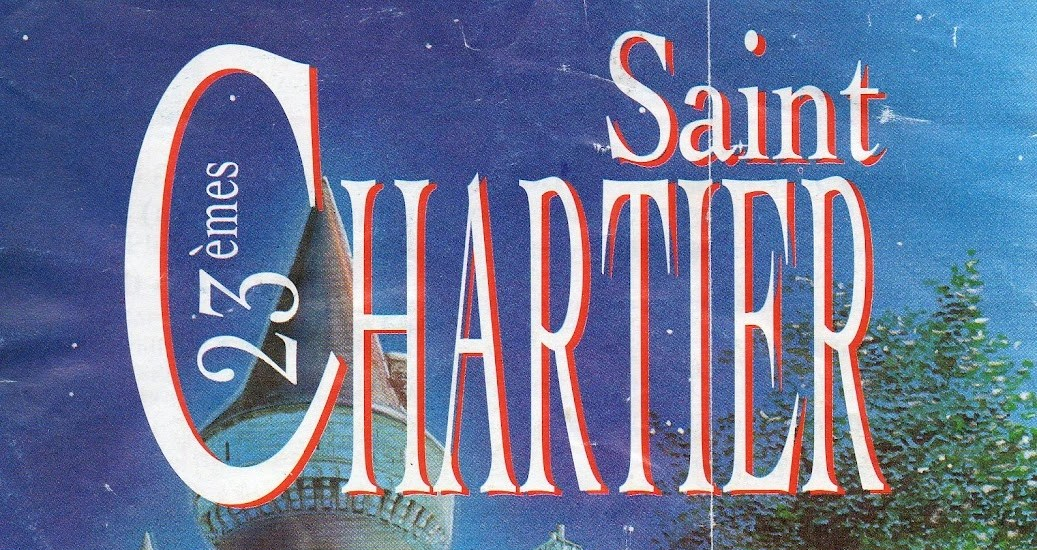
A nostalgic review of what was the best music festival in the world.
Contents
Festivals
There are, of course, many music and arts festivals. In the UK we might pick out Glastonbury as the largest, WOMAD for a wonderful range of world music, and in the folk music world we have Cambridge, Folk East, Towersey, Sidmouth etc. I particularly enjoyed the festival at Rudolstadt in Germany. But which is best? Well I’m afraid the answer is none of these.
For those who were lucky enough to attend, way back in the day, THE best festival was held in the small village of Saint Chartier, not far from La Chatre in the Indre department in central France. To give it it’s full name, “Le Rencontres Internationales de Luthiers et Maîtres Sonneurs” – that’s “The International Gathering of Instrument Makers and Master Musicians”, in English.

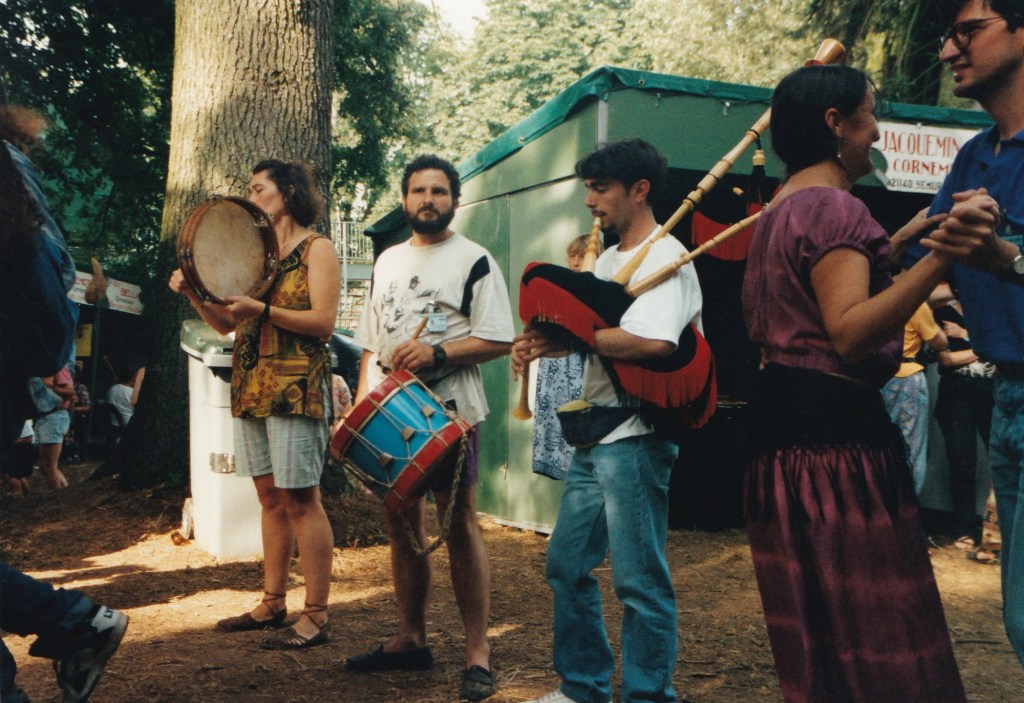
What made it unique was there was as much emphasis on those who made the instruments as on those who played them. It was, at least in part, a trade show for small instrument makers. And we’re not talking about Gibson, Hammond etc – those are mere planks of wood and wooden boxes. No – here we’re into older, earthier, more organic instruments which chiefly fit in the folk and early music world. Instruments that grab you by the throat and demand your attention.
In short, it’s about DRONES. Specifically, bagpipes and hurdy gurdies, plus, of course their friends and relations – whistles, bombardes, shawms, fiddles and even (ahem, cough), accordions.
But lets go into more detail, for whilst it’s a world the initiated relish – indeed luxuriate in – for newcomers it can take a little effort to tune into. The presence of a fixed drone accompaniment requires the tuning of the chanter to be adjusted slightly away from the more modern equal tone temperament. So called ‘just’ temperaments are the rule here; a small, but important adjustment, where the notes of the chanter are all related the drone note by rational numbers. (That’s numbers that can be represented as a fraction of two integers – 3/4, 5/7 etc.) The result is an increase in power and depth of the sound, as the individual parts of the instrument bond together in a more homogeneous untity. Not only this, but the melodies played tend to be much more based on the ancient ‘modes’ – aeolian, dorian, mixolydian etc – rather than modern functional harmony. The overall result is beautiful, but on first listening it can sound a bit strange, though the listener can’t always work out why.
So lets look at the two major classes of instruments in this category: bagpipes, which are part of the woodwind class of instruments, and hurdy gurdies, which are their stringed equivalents.
Bagpipes
If you mention bagpipes to people in Britian, they usually assume you’re talking about the Great Highland Bagpipe (GHB) of Scotland, or perhaps if they’re a bit more musically savvy, they might enquire whether you mean the Northumbrian Small pipes or the Irish Uilleann pipes. These are all very fine instruments of course, but they only represent a small part of the fantastic range of bagpipes which can be found throughout Europe and rest of the world.
For example in central France where Saint Chartier is located, the magnificent ‘Cornemuse de Centre‘ is the mainstay. Its a generic style comprising a conical chanter, which is nearly chromatic over about one and a half octaves, and 2 or 3 drones pitched 1 and 2 octaves below the chanter. The higher pitched drones are mounted in the same stock as the chanter. It’s scalable so whilst the basic pitch is usually either ‘G’ (16 inch) or low ‘D’ (20 inch), it can be set anywhere between an octave higher or lower. It’s a lovely bagpipe.
In Brittany, where they also play the GHB, the have probaby the smallest of all bagpipes in the ‘Biniou Kozh’. This is very high-pitched pipe, commonly played as a duet with a bombarde. Its sound takes a little getting used to, but it really is wonderful once your ear is turned on to it.
In Spain, where they have an unbroken tradition of bagpipe playing spanning 400 years (possibly longer than Scotland), the generic term for bagpipe is ‘Gaita’. Typically these are loud, proud instruments with up to 3 drones and usually played with lots of percussion and attitude, but there is also a wider range of pipes from the region as described here.
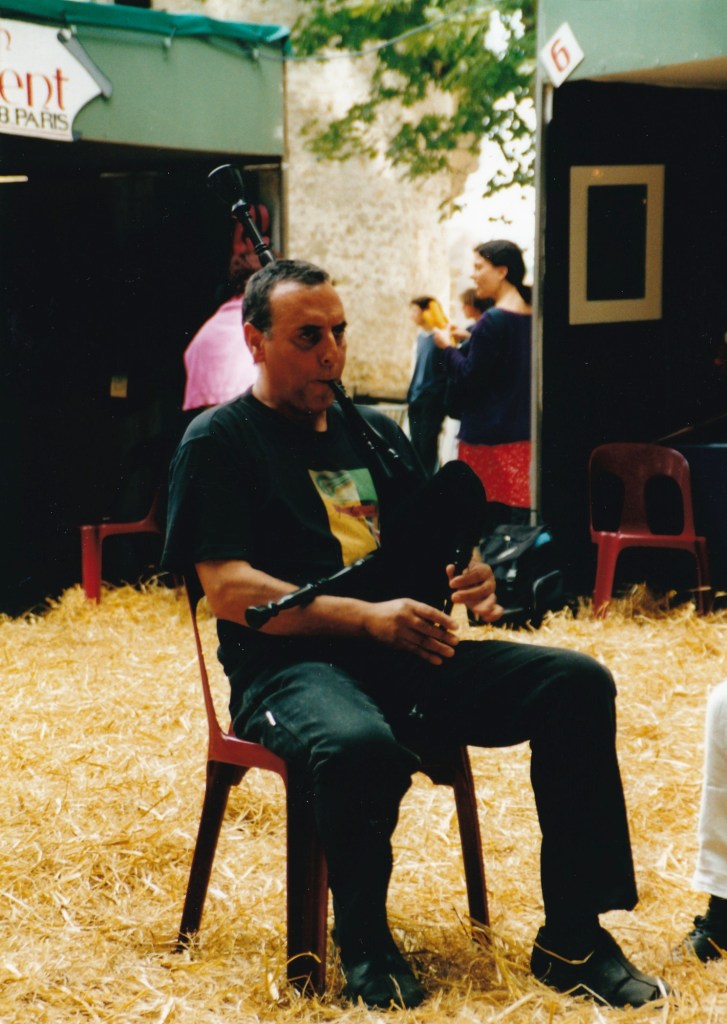


Even in England, where with the exception of Northumberland, bagpipe playing had died out by the mid nineteenth century, there were several distinct bagpipe styles.
In modern times luthiers like Julian Goodacre are making reproductions of historical instruments. Jon Swayne makes a range of historical pipes and also his ‘border pipes’, which feature a chromatic chanter supported by 2 or 3 drones held in a common stock. They’re wonderful, and he also does a more affordable student version.
But there’s too many to cover here, so possibly unwisely, I’l give you a Wikipedia link.
The Hurdy Gurdy.
The hurdy-gurdy shares some of the features of the bagpipe – drones, chanter etc, but does it with strings. It also has, unlike a bagpipe, a rhythm component in the form of the buzzing ‘trompette’ and a fuly chromatic keyboard over (usually) two octaves. The latter enables, for example, a minor 2nd to be played against the drones, and the former allows individual notes, or sometimes the background rhythm to be accentuated with a buzzing tone. It is a beautiful instrument, in the right hands capable of great expression, though it has also been described, quite accurately I think, as ‘acoustic grunge’ (though I don’t think Kurt ever discovered it!).
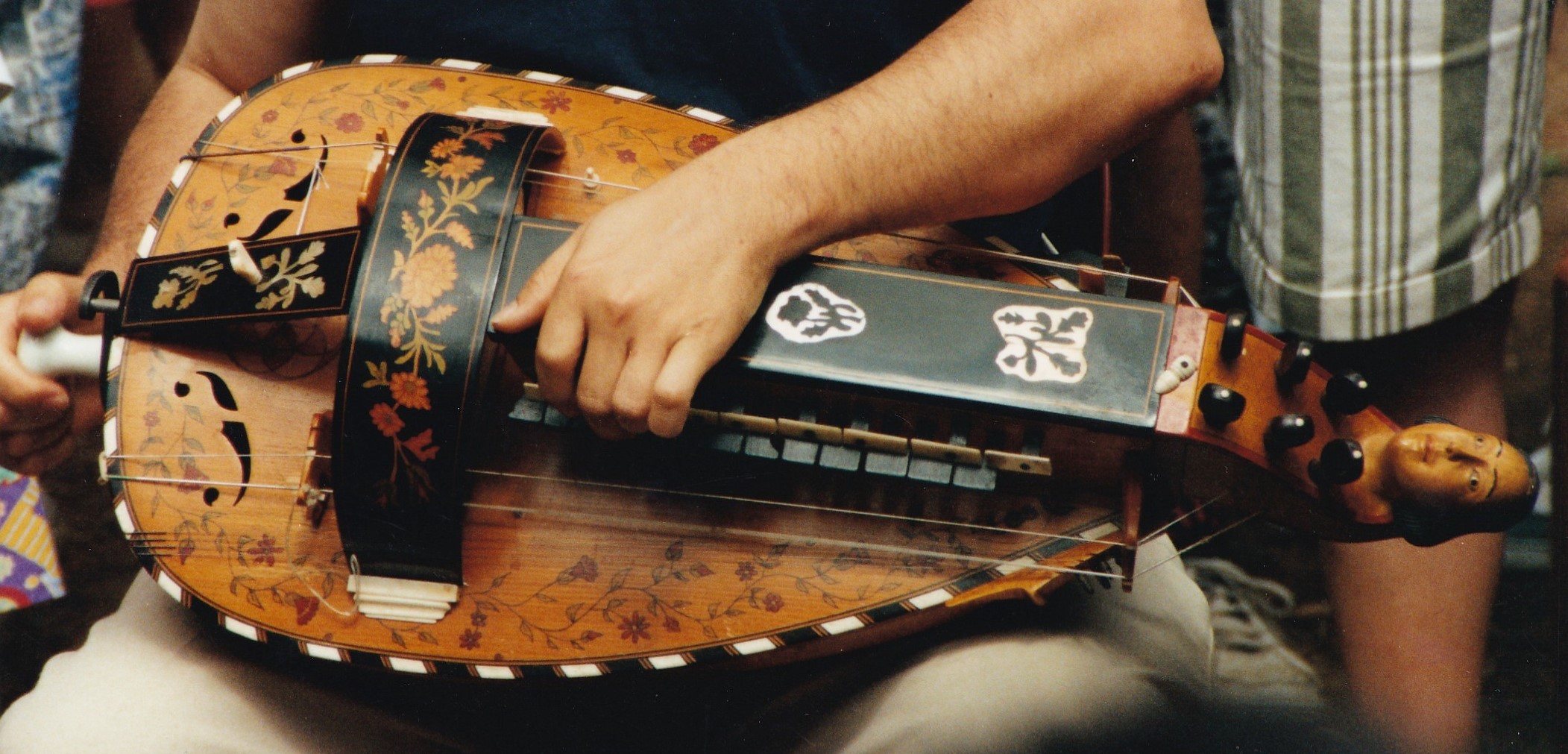
Essentially what you have is a bowed stringed instrument where the bow is replaced by a wheel which is set up to excite both chanterelles (melody strings either in unison, octave or other interval), and fixed drones. It also excites a unison drone featuring a kind of lose bridge ( the chien, or trumpette) which is set up to make a buzzing sound at higher volumes. This makes it essentially a ‘band-in-a-box’ instrument – melody, accompaniment (drones) and rhythm all in one. Its actually a very expressive instrument when played tastefully, but this is difficult – I’ve been trying for years. There is a substantial body of music written for it, particularly in France during the late 18th century. The basic shape has many variations – flat backed similar to a guitar, lute backed, or basically any shape the luthier decides to use.
It’s name changes depending on which part of Europe you’re in. ‘Hurdy Gurdy’ is common in the UK and USA, but the rest of Europe generally use vernacular terms based around the term ‘wheeled fiddle’: e.g. ‘vielle-a-roue’ (France), ‘dralier’ (Germany), etc.


The traditional baroque tuning for the hurdy is what’s called the C-G tuning, where the chanterelles are tuned to G, and the drones to G and D, or C. An alternative, or ‘bourbonnais’ tuning, is has chanterelles in D (octave spacing) and drones in D. This works very well when played with the cornemuse de centre pitched in D and is also very useful for celtic music, which typically has a key-centre in D. There are other traditional tunings, and of course the musician has the freedom to set the drones to any chord they chose.
Modern hurdy-gurdies can be very sophisticated, featuring complex electronic amplification, variable pitch drones, auxiliary fretboards etc.
A short film by Fred Hines, The Hurdy-Gurdy (Reviving an Ancient Sound), featuring some top players and luthiers is available on Youtube.
The event.
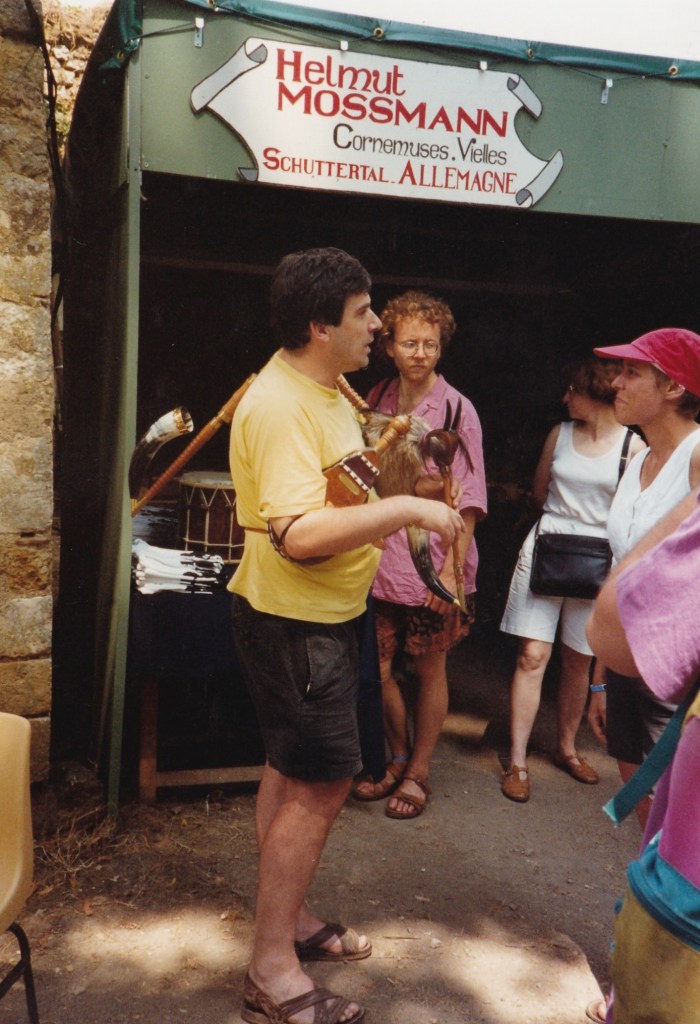
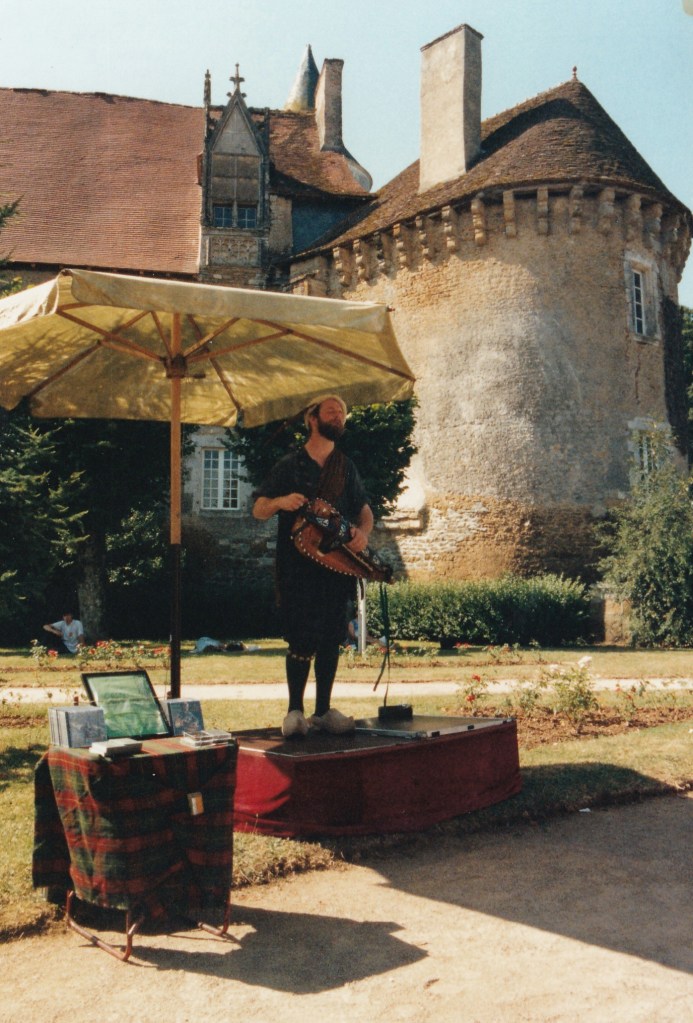
Typically there would be over 80 stalls set up in the garden of the Chateau de St. Chartier where luthiers would be displaying their creations. Vast numbers of musicians would attend to play, buy and sell instruments. People would play – just for the joy of it! It was an extraordinarily friendly event with visitors from all over Europe, and often further afield. There were competitions for the best bagpiper and hurdy-gurdy players, demonstrations by luthiers, and international concerts in the afternoon And by ‘international’ I mean just that – I recall seeing a Sweedish nyckleharpe band, a Portugese group, and a Tex-Mex band at different times in the afternoon. I particularly loved the group ‘Jams’ from Germany.
A big concert was put on in the evening. This was again, often varied – on one evening a delicate early music group supported the Sweedish powerhouse Hedningarna. What a contrast! A year or so later, La Bottine Souriante from Quebec were magnificant.
Then, starting in the late evening, the real party began in the village square, where no less than 5 dance floors with associated stages had been set up. There was no formal organization or bands booked – you just joined the musicians if there was space and you thought you could add something to the sound, found a partner if you could dance, or simply listened and enjoyed the atmosphere. There was usually an unofficial Breton dance by the village church steps and sundry other sessions going on on the fringes. An English friend said she wanted to bottle the atmosphere to bring it out on a winter’s evening at home. I know what she meant.
The dancing would continue all night until about 7am when everybody would parade down the road to the village cafe when it opened for breakfast.
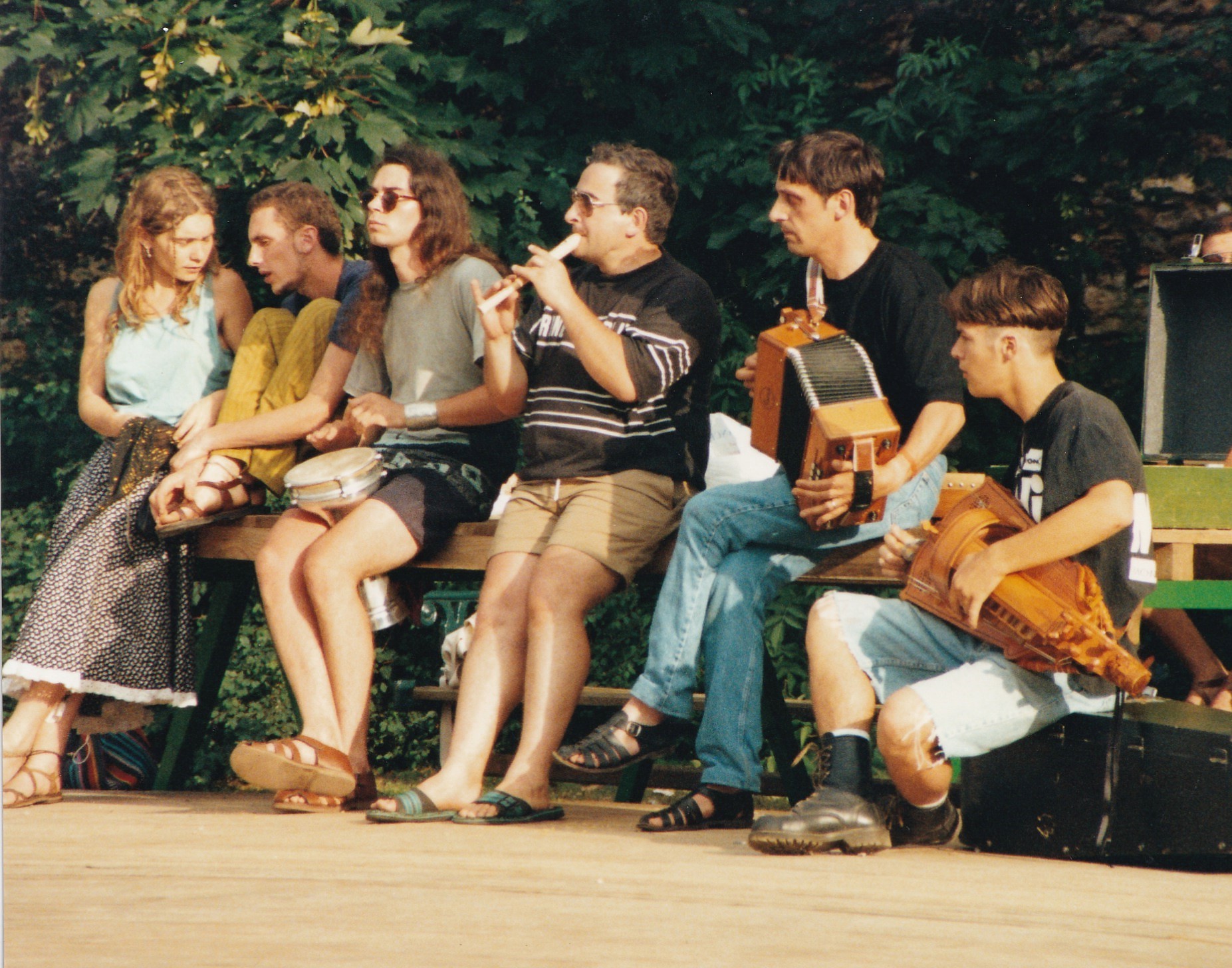


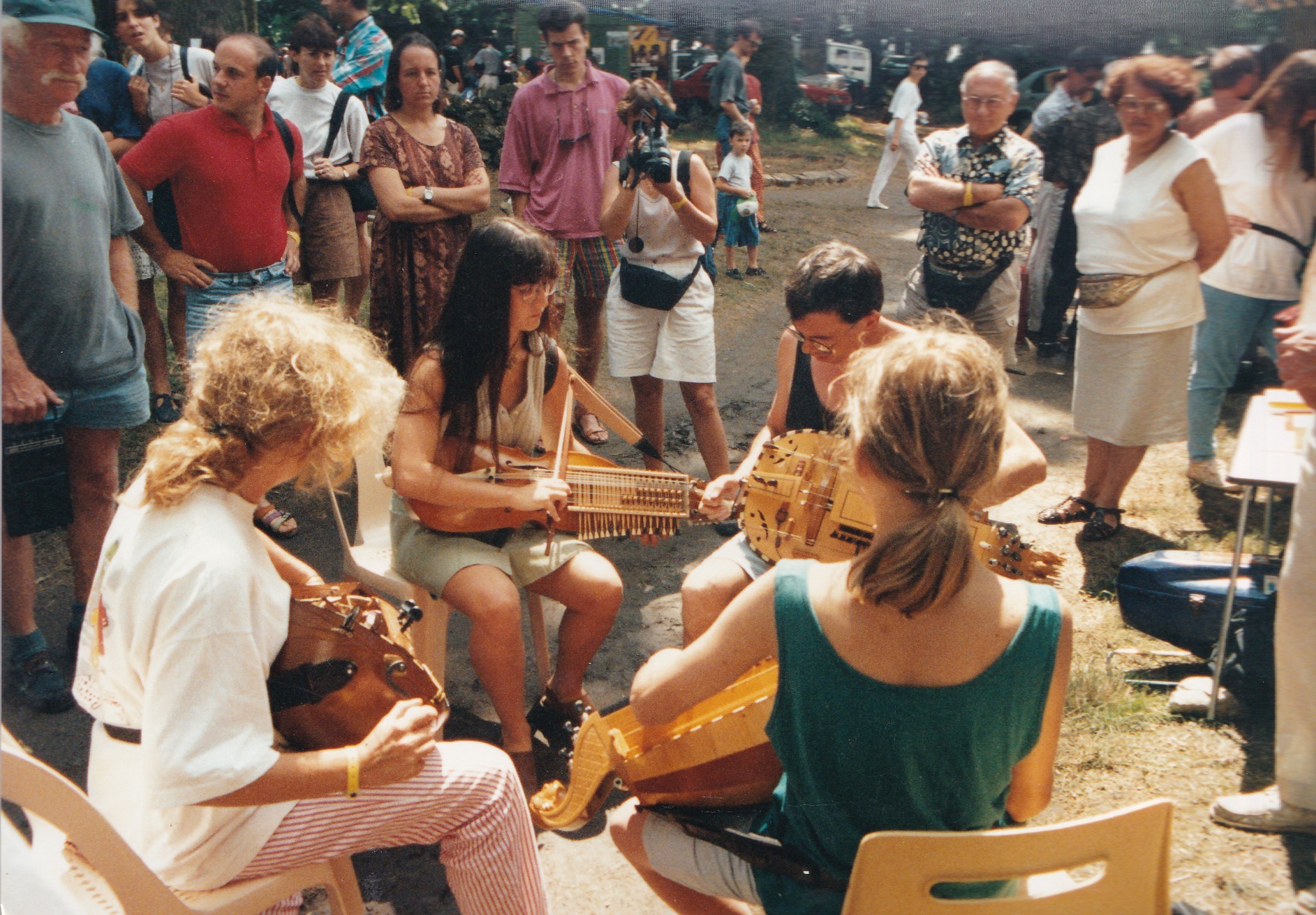
It was brilliant. There was something about the place that made you want to take your instrument out of its case and start playing. Frequently large informal sessions would develop, featuring well over 20 people. One of the nice things was how inclusive the sessions were – if a tune is worth playing once, then it’s worth playing 10 or more times, so everybody has a chance to learn it.


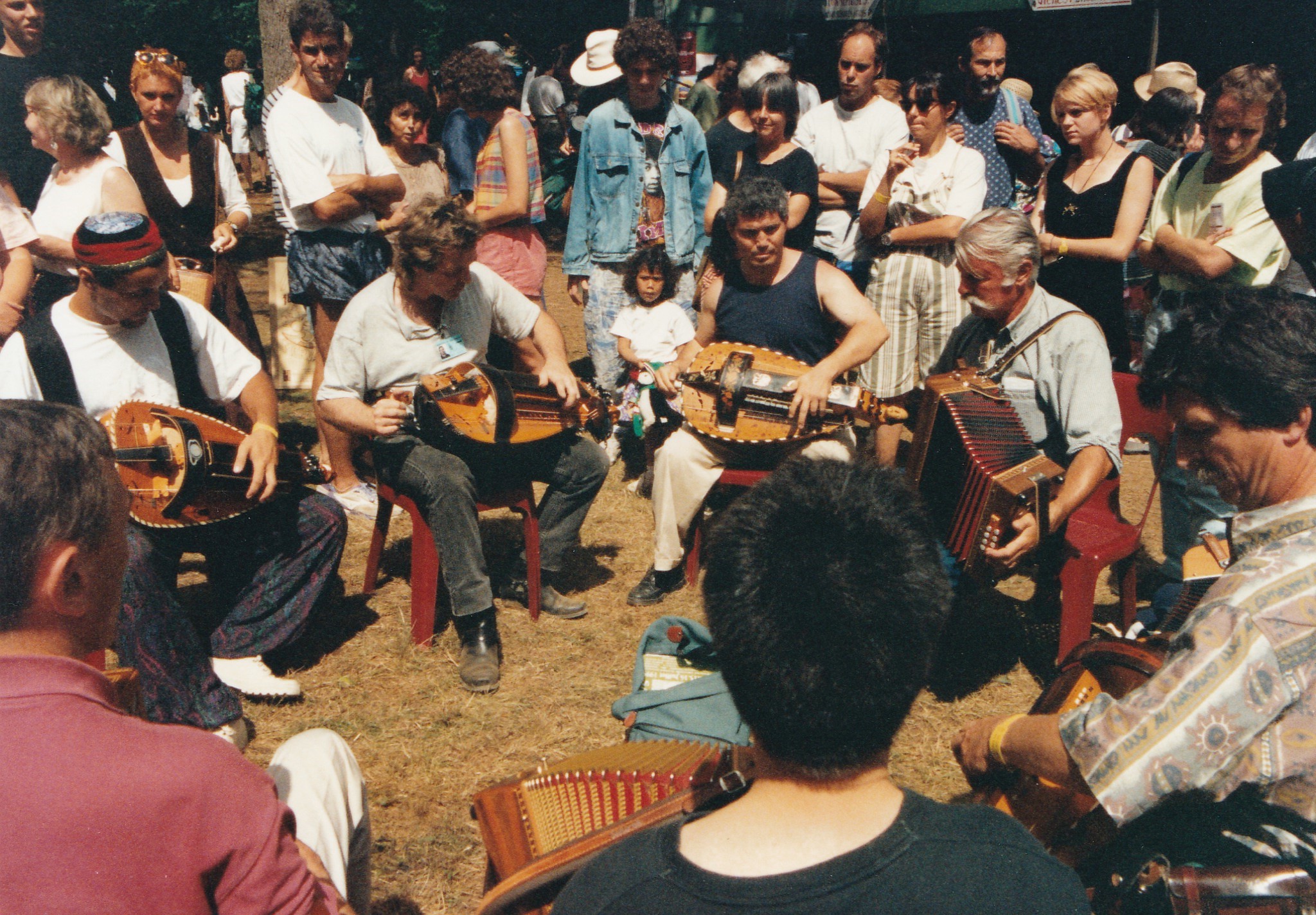
There was also what might be described as a festival fringe. Whilst it was necessary to pay to enter the chateau grounds where the formal events were held, camping was free, as was access to the rest of the village with it’s bars and open areas. Thus, if money was a bit tight that year, you could still come along and enjoy the event.
You can get a flavour of the event from this video, and also Julian Goodacre’s tribute to the festivals founder, Michele Fromenteau.
Sadly, the festival in Saint Chartier is no more, but the event continues at the nearby Chateau D’Ars, where it has been re-named Le Son Continu.
The Music
During the festival it was a very common practice to share tunes around, and recording other people playing was practically endemic at times. In fact, it sometimes seemed that if you started playing and nobody pulled out a microphone, you might deduce there was something wrong somewhere.
I recently stumbled across a box containing a large number of cassette recordings I’d made at the festival during 1994 to 1999, and then forgotten about. Some were a little rough, some of them seemed quite good, and they certainly evoked some happy memories so I’ve digitised a selection and they’re available below. (I’m assuming there’s no copyright issues here – please let me know if there are!). Let me know what you think in the ‘Leave a Reply’ section below – there’s loads more!
Competitions
Solo bagpipe. Unknown performer.
Solo Vielle. (I think this might Stephane Durand.)
Various small groups
Hurdy gurdy waltzes. (Tunes are, I think, by Bernard Kerbouef.)
A german trio recorded by Helmut Gotschy’s stand. The believe the hurdy gurdy player is Konstanze Kulinsky. The bagpipe is a hummelchen, a smalll German bagpipe.
Playing at the campsite 1. Dominic Allan (Swayne low ‘D’ bagpipe), Phillip Martin (hurdy- gurdy)
Playing at the campsite 2. Dominic Allan (bagpipe), Phillip Martin (hurdy- gurdy)
Big sessions and dances
Large groups playing either in the park or at the dance stages
Dromedaire – La Charge. Cast of thousands, lead by Patrick Bouffard.
Sansonette

3x bouree
Polka
Scottiche a Virmoux
Jig (Name: ??)
Les Poules Huppees – 3x bouree.
Le Grande Orchestre de Vielles et Cornemuses.
Large (300ish) orchestra performing in 1995. All kept in time by a large drum which, sadly, rather dominates the sound.
Photos, links to videos and music scores are here.
Valse a Cadet.
Marche a Compagnon.


The experimental.
Any man or woman, particularly a creative one with a workshop and tools they know how to use, will sometimes turn his mind to making something that pushes the boundaries; something different, something to advance the ’cause’ – whatever that may be. Partucularly during those dark winter months when it’s cold and wet outside, the workshop filled with the aroma of a range of solvents, and the mind tends to be at its most creative. Whilst improvements on the wheel may be difficult to achive, a new “<name>-o-phone” is always possible.
Thus one luthier exhibited a hurdy-gurdy that featured 2 interlocked wheels. It seemed to work, but it wasn’t clear what benefits it gave. Similarly, I have a vague memory of one excellent bagpipe maker turning up at the Bagpipe Society meeting in the UK with an experimental bagpipe that seemed to be based around a colostomy bag.
This is all good. Experiments are important, otherwise everything stagnates.
At the forefront of such developments during the 1990s was Dominic Allan. Dom is a fine luthier of course, but he liked to push things a bit. One of his finest creations, circa 1999, is the ‘Red Bagpipe’. It’s not really clear whether this was based on an extra terrestrial experience, domestic pluming, or simply anatomically inspired. There certainly seems to be a ball-cock integrated into the design anyway. Magnificant – 10/10.

Another of Dom’s creations is shown below. This is definitely somewhat more experimental, indeed guttural, requiring 3 persons for a satisfactory performnce. I think his instructions to me on the one occasion I served as the ‘blower’ (at the rear), was to “blow like f**k”. I wasn’t clear at the time what this actually entailed, but overall the audience seemed to respond very positively towards our combined efforts.
The End
Sadly, around 2008, the Rencontres de St. Chartier came to an end. Partly because it became a victim of it’s own success – there’s only so many people a small French village can accomodate – partly for financial reasons, but mainly because the Cheateau was sold to a new owner who had no real interest in continuing the event. A shame, but all good things come to and end. By that time I’d married, had a small family and my priorities were vey much changed.
But for several years the festival was the highlight of my summer. I met many wonderful people and made some great friends during what was, up to that point, some of the happiest times of my life.
Salut!
Links and References
These days the interweb is awash with websites dedicated to enthusiasts of all types. Google is obviously your friend here! The following is a small selection.
| https://gurdyworld.com/ | A site dedicated to all things hurdy-gurdy. | |||
| http://hurdygurdy.org/ | Website of makers Chris Allen and Sabina Kormylo. | |||
| https://www.claire-dugue.com | Website of Hurdy Gurdy maker Claire Dugue. | |||
| http://www.lesoncontinu.fr/ | Website for Le Son Continu – the successor to St. Chartier. | |||
| The Hurdy Gurdy Community. | A very active Facebook group for the Hurdy Gurdy . | |||
| The Bagpipe Society. | The UK based Bagpipe Society. | |||
| Bagpipes of Central France. | Facebook group dedicated to bagpipes from central France. | |||
| Nigel Eaton live- with Page and Plant, 1996. | The loudest hurdy gurdy in the world! | |||
 The Sheeprug Pages.
Fantastic effort. This keeps something wonderful alive that would be gone forever. Hope you keep at it.
LikeLike