
Astrophotography is an interesting blend of art, science, photography and image processing. The problem it’s trying to address is, how do you take photographs of objects in the night sky that are incredibly faint – barely visible in fact – even with a large telescope? If you look at the night sky on a dark, moonless night you will see hundreds – thousands even – of stars. Lets take a closer look you think, so you take a telescope – even a cheap one – and find that a star magnified by the telescope is still a tiny point of light. A bit brighter perhaps, and you may see a few more stars nearby, but that’s all. In fact, less than 1% of stars are particularly interesting at all, even using something amazing such as the Hubble Space telescope. Some stars are in fact multiple stars, and these can be very pretty – Alberio for example – but the simple fact is most of the interesting things out there in space are not very bright at all. In fact they’re very dim, which is why astronomers get very upset about light polution – it masks everything you might want to look at.
As an example, take the great galaxy in Andromeda – theres a picture of it further down the page. It’s one of the few things in the night sky that isn’t a star or a planet, but still can be seen with the naked eye. Visually, at a dark site, it’s a faint smudge a few degrees below the constelation of Cassiopiea (the big W shaped constelation). Not very interesting really, but it looks somwhat better, through a small telescope. What you’re actually seeing though, is the biggest, oldest and most distant object you’ve ever seen. The reality is, it’s absolutely enormous, and at least 20,000 times further away than any of the other stars you can see. By eye – a faint smudge; by photograph – an immense object which appears somewhat wider than the moon.
Because the distances are so vast, astronomers use the basic measurement unit of a ‘light year’ – that’s the distance light travels in a year. To put it in more familiar units, a light-year is about 9500,000,000,000 kilometers. That’s 9.5 million million kilometers.
So, how do you do it? Well there’s several approaches, but i’ll explain the method I use. You need the following:
- A digital camera
- A suitable lens – 100-200mm is good for widish shots, 3 or 4 times that for narrower views.
- an equatorial mount so you can track the stars movements.
- a computer with appropriate software.
The method is then;
- Point the camera as necessary
- take lots of photographs, all pointing at the same target. Typically this might mean 20-30 exposures of about 2 to 5 minutes long. ie. a few hours in total.
- Use software to ‘stack up’ all the pictures.
- Use photoshop or similar software to adjust the brightness and contrast so the really dim thing you’re aiming for is visible, but the rest is not washed out. This is the ‘arty’ bit.
- In most cases you then look at the result, decide it’s not good enough and hit delete.
- On the rare occasions it does look OK so you proudly show it to your friends.
Below are some of my pictures that did work. All were taken from my garden.
Galaxies
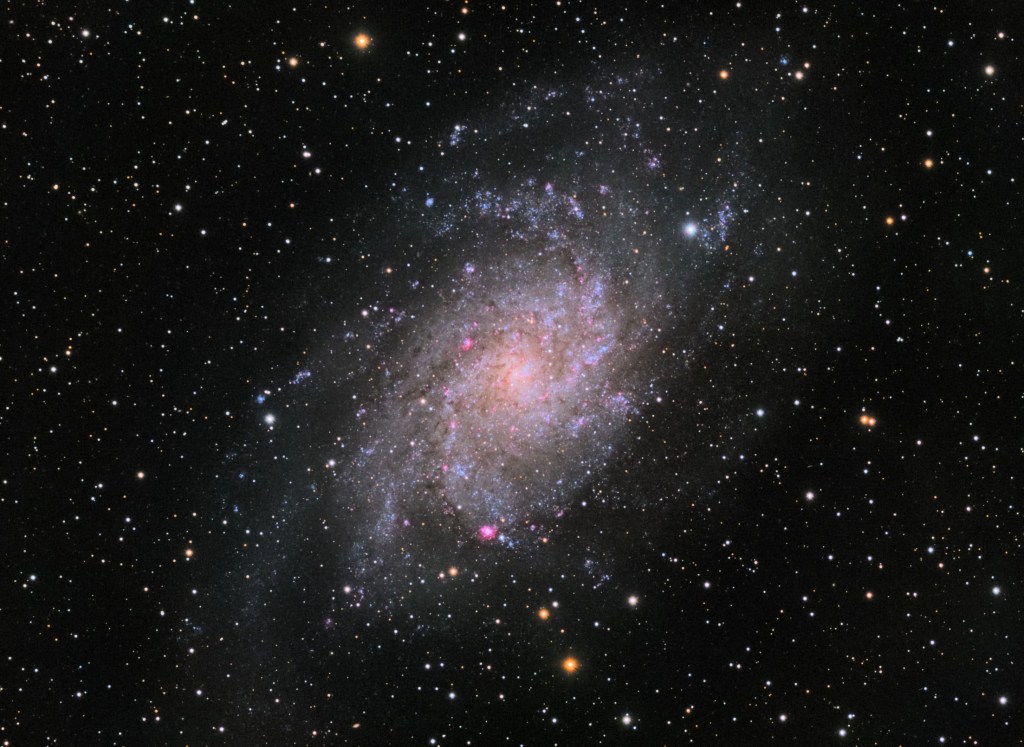
Distance: 2.73 million light years, diameter approx 60,000 light years.
Unbarred spiral type.
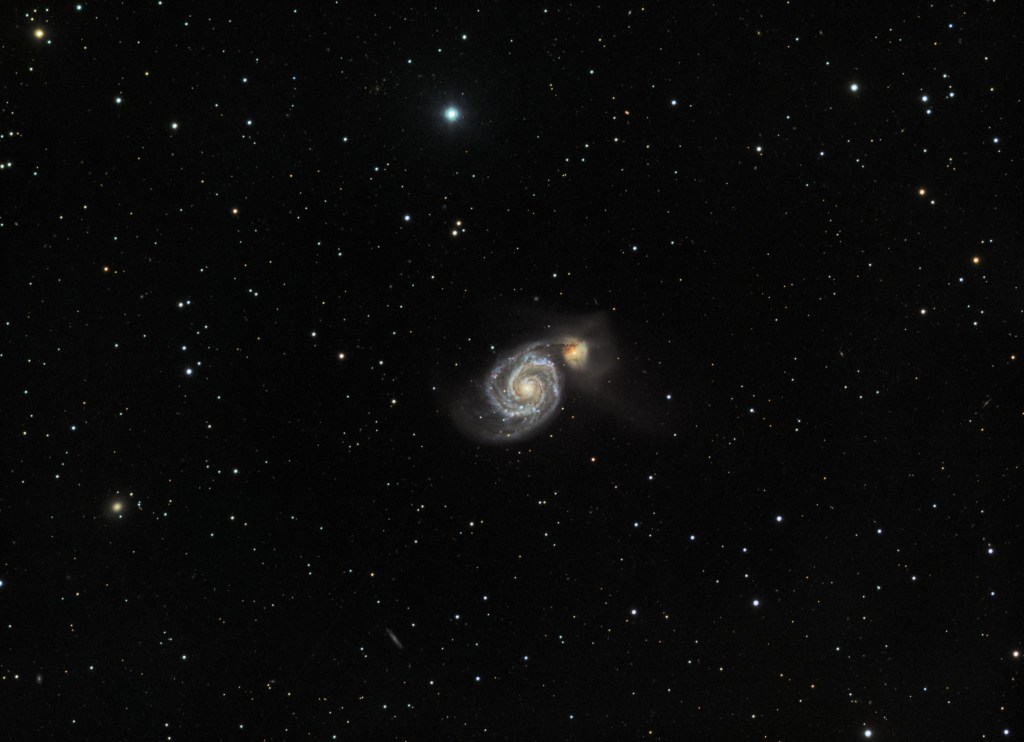
Distance 23 million light years, diameter approximately 76,000 light years.
Along with its companion, NGC5195, it forms a interacting pair of galaxies.
Photographed in March 2020 using approximately 4 hours of exposure.
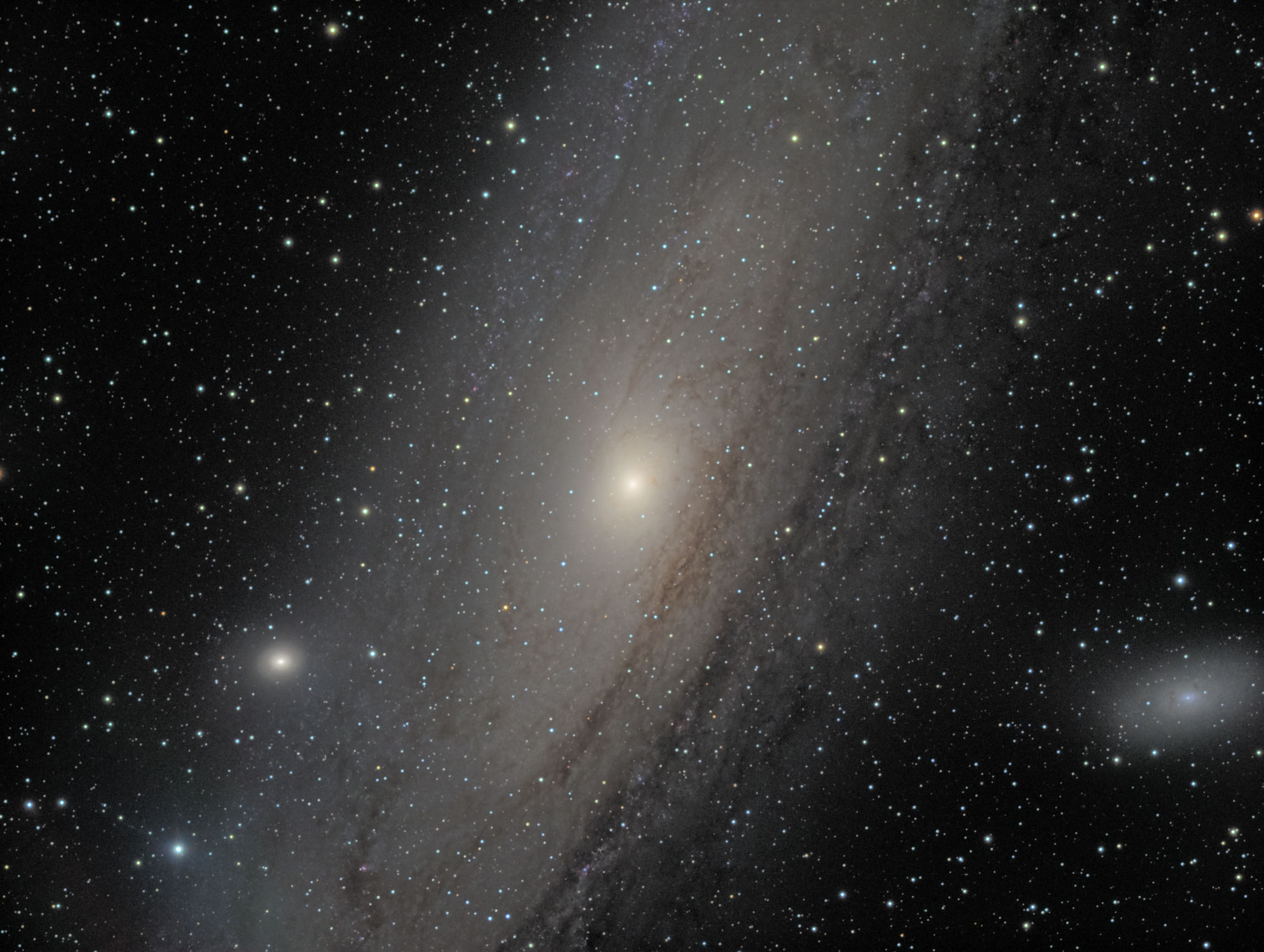
Distance: 2.5 million light years, diameter: approximately 220,000 light years.
Spiral galaxy, note 2 smaller eliptical galaxies, M32 and M110
Star clusters.

Globular clusters are tightly held together clusters of very old stars, found in the halos of larger galaxies. They are quite common – our Milky Way has over 150 of them.
Nebulae

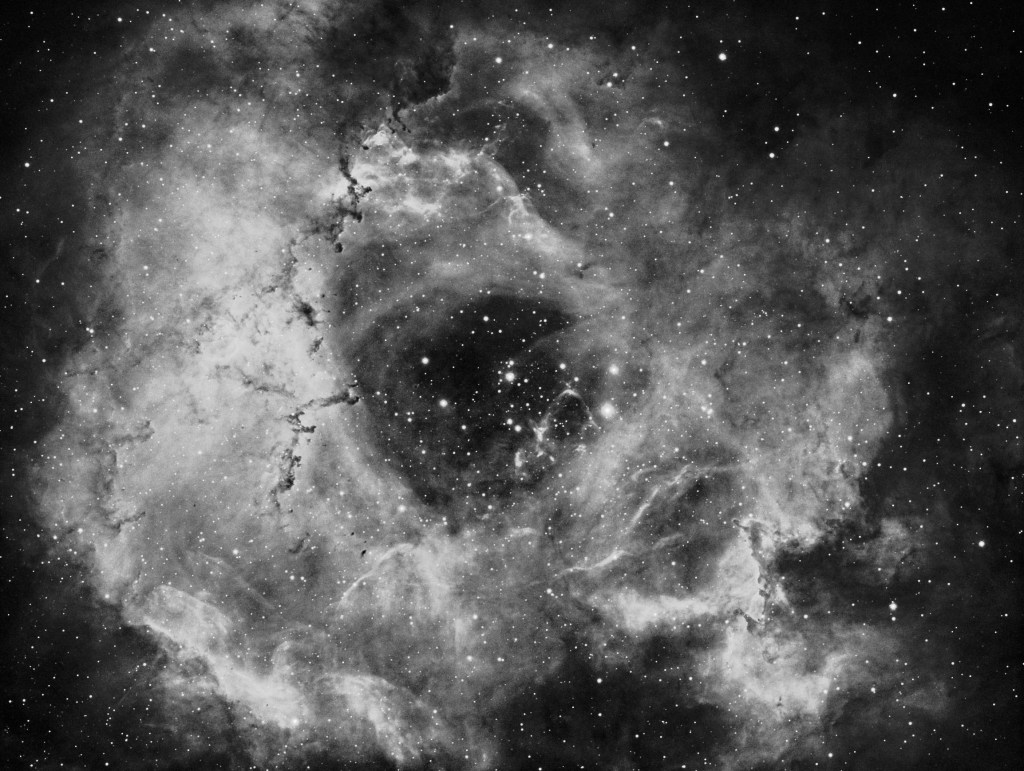
An emission nebula.
Distance: about 5000 light years away, diameter about 130 light years.
Photographed in narrow band Hydrogen-alpha. (Colour version to follow…)
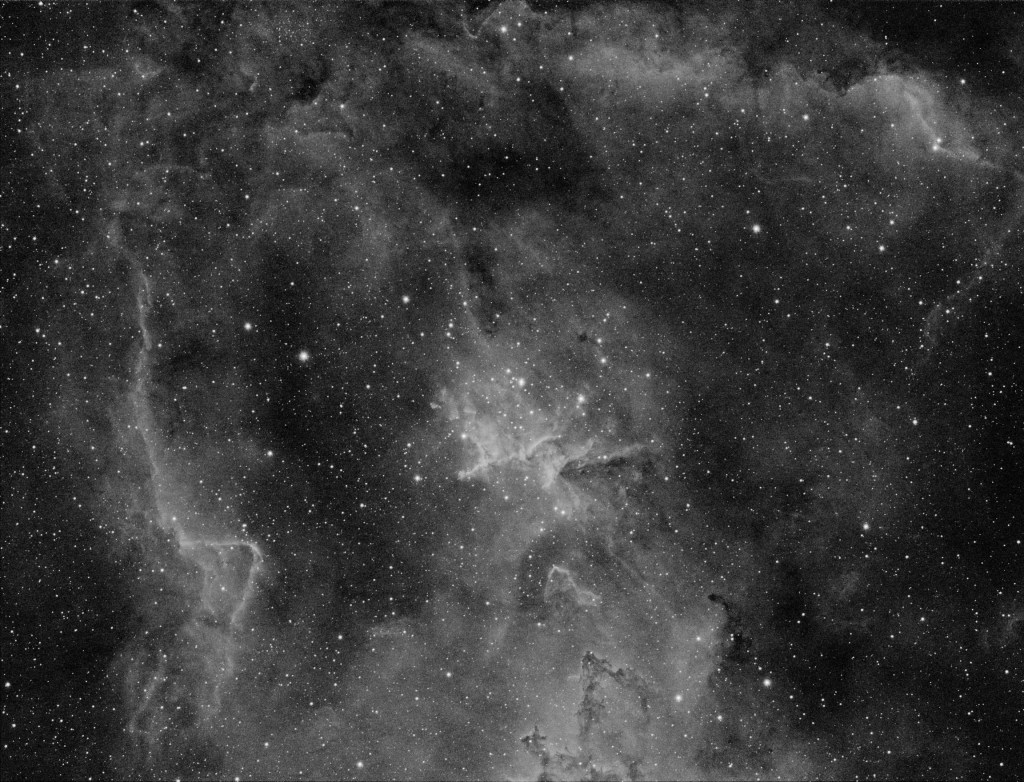
So called because when it’s all visible it looks like a heart.
Also Hydrogen-alpha.
 The Sheeprug Pages.