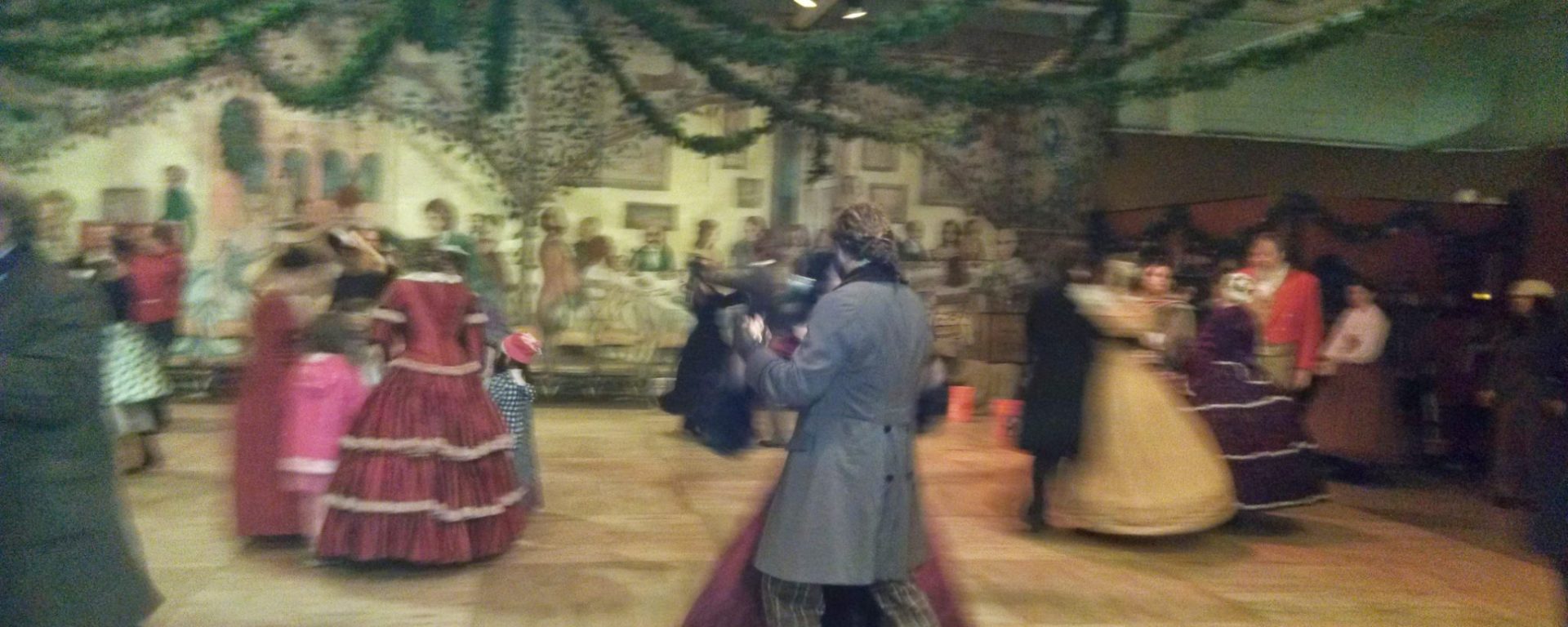
This is one of my favourite newspaper articles from Victorian Hasketon.
Thomas Haines [B. Edgbaston 1842] had served for many years in the Norfolk Regiment, rising to the rank of Colonel, before retiring in 1892 to take up residence in Hasketon Manor, along with his wife, Mercy, and 3 children. This account, from the December 31st 1892 edition of the East Anglian Daily Times, describes in some detail their very lavish house warming party which took place on December 29th 1892.
Previously I’d edited the article down quite severely so it could fit in the parish magazine, but this is now the full version. It includes more details of the Manor House, the guests and their costumes, and the party activities. The majority of the music at the event was performed by the Suffolk Artillery Militia, who played at many events at this time and seem to have been highly rated. The list of music they played is particularly interesting since it illustrates what was popular in late Victorian England. Many of the composers are relatively unknown today, but overall, it seems to be a very lively Viennese style programme.
I’ve provided a few links to performances on Youtube so you can re-create some of the ambience at home. Note that dance tunes from this era often included a longish introduction to give the dancers time to get themselves organised. I’ve also included an ‘easter egg’ for your enjoyment!
Sadly Col. Haines didn’t get to enjoy life in Hasketon for many years after this – he died in 1895 and is buried in Woodbridge.
FANCY DRESS BALL AT HASKETON MANOR.
Hasketon Manor House was on Thursday night the scene of a large and brilliant gathering of county society. Within the past twelve months Colonel Haines has purchased this commodious and well-situated residence, and his “house-warming,” which fell in most happily within the hospitable traditions of Christmastide, assumed the form of a fancy dress ball, for which invitations were issued to a wide circle of friends and neighbours. It need hardly said that these invitations were unanimously accepted, or that the event was anticipated with immense pleasure. Great was the excitement in many households: deeply interesting and mysterious were the preparations made by younger and fairer members of the family circle. Happily, when the occasion came at last, the hope of enjoyment was most fully realised. It was the ideal winter party, held under conditions which suggested the gracious and romantic memories associated with olden times. Outside, the air “bit shrewdly”, trees and shrubs were covered with frosty rime, the roads were hard as iron, and even to riding closed carriage there was a delicious spice of hardship. Inside, every room was ablaze with light, for dancers and “sitters-out” every comfort was provided, and the cheeriest and heartiest of welcomes was accorded to all guests by Colonel and Mrs. Haines and the members of their family.
Into the details of the arrangements made for a private “function” of this character it would be unnecessary and impertinent to enter. The Manor House in Hasketon atones in roominess and comfort for all that may be lacking in old-fashioned picturesqueness, and on Thursday night it was decorated throughout, with charming “lightness of touch,” by Messrs. B. D. and J. B. Fraser, of Ipswich. In the porch were groups on either hand of flower and foliage plants; the entrance hall was laid with Turkish rugs and carpets, while there were sprays of holly behind pictures and ornaments on the walls, and a branch of the magic mistletoe in central and convenient spot overhead. The great staircase beyond was draped on rails and balusters with the new oriental “Liberty” hangings. These soft and beautiful fabrics, which are wrought white and gold and many lovely colours, were largely used throughout, at the entrance to different apartments, and more especially in the construction a recess which represented the crowning effort of additional adornment. The broad corridor on the first floor, and a large room adjoining were set apart for dancers, and the recess in question was placed a raised landing at the end of the corridor, which commanded the best possible view of the gaily-dressed company when all were assembled. It was partitioned off by a quaint looking Anglo-Arab arch, and the curtains opened upon luxurious seats and ingle-nooks placed in the form of a Turkish divan. Card and smoking rooms were provided the storey above, and in the dining-room below supper was served in sumptuous style. The place of honour was occupied by the traditional boar’s head, the tables were brightly and prettily laid, and the bill of fare included delicacies which could only be indicated in the untranslatable French of the menu card.
The guests arrived in quick succession after nine o’clock, numbers coming for many miles over the icebound roads, and awaking, in double sense, the interest of residents in lonely country districts. Two bands were engaged—those of Colonel Haines’s own regiment (the 4th Norfolk), under Mr. Cammings, and of the Suffolk Artillery Militia, conducted by Mr. Fred Harris. The former played introductory, occasional dance, and entr’acte music, to speak, but the greater part of the following attractive programme was splendidly played by their musical comrades:
Waltz:                  ”Ces bons geus Province”.                           Czibulka.
Waltz:                  “ Santiago”                                                  Corbin.          Listen (1908 recording)
Polka:                  ”Bredouille”                                                 Strobl.
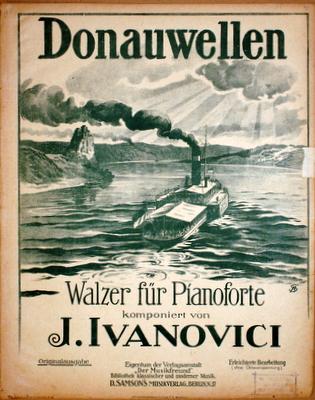
Waltz:                  ”Donauwellen”                                             Ivanorvici     Listen
Lancers:               ”Talk of the Night”                                       Williams.
Waltz:                  “Pfingsten in Florence”                                Czibulka.      Listen
Waltz:                  ”Donauweibehen”                                        Strauss.        Listen
Polka-:                 ” Farfadet”                                                   Fahrbach.
Waltz:                  “Am Neckarstrand”                                      Millocker.
Waltz:                  ” Joie envolee,”                                             Waldtenfel.    Listen
Polka:                   “La Tour Merveilleuse”                             Fahrbach.
Waltz:                  “Suspinul”                                                    Ivanovici,
Lancers:               “Gondoliers”                                               Sullivan.
Pas de Quatre                                                                            Lutz.
Waltz:                  “Traum”                                                        Millocker.     Listen
Polka (vocal):     “Hi Kelly”                                                     Gaggs.
Waltz:                  “Sudbuilder”                                                 Fels
Polka:                   “ Les Folies”                                                Waldteufel     Listen
Lancers:               “Old Edinboro”                                            Kenyon Lees.
Waltz:                  “Fest und Treu”                                              Fucik.
Gigue                   "Vorrei che fosse Natale tutti i giorni"         Mago            Listen
Waltz                    ”Lundliche Bilder”                                        Czibulka.
Waltz:                  “Ballrosan”                                                    Docker.
Polka:                   “Holly Bush”                                                Godfrey.
Gallop:                 “Across Country”                                         Meissler.
Nearly 200 invitations were issued, the list including: Colonel and Mrs. Barlow and party, Mr. Edmond Barlow, Rev. T. H. Simpkin, Mrs. White and party (Bredfield), Major and Mrs. Howey and party, Mr. and Mrs. Dudley, Miss Dudley, Capt. Yolland, R.E., Mr. and Mrs. Hudson and party, General and Mrs. Hessey and party, Mr. and Mrs. Eager and party, Mr. and Mrs. Holme White and party, Mrs. Wood and party (Melton), Dr and Mrs Wood (Woodbridge). Mr. and Mrs. Alexander and party, Dr. and Mrs. Ker, Dr. and Mrs. Henley and party, Dr. Hollis, Dr. and Mrs. Kirkpatrick, Dr. and Mrs. Airy and party, Capt Theobald, R.N., and Mrs. Theobald, Mr. and Mrs. Carthew and party, Capt and Mrs. Carthew and party. Capt. Aldrich, R.N., and Mrs. Aldrich, Mr. and Mrs. Harrison, …..(The list of invitees goes on forever, so I’ll stop there – Ed.)
The “parties” included in some instances a number of ladies and gentlemen, whose names are consequently omitted. As already indicated it was a brilliant gathering, and although not all the visitors were in fancy attire, a most bewildering variety of characters and costumes was assumed, the result being that the scene in the ballroom was full of colour and picturesque beauty.
An excellent example in good taste and effectiveness was set by the house party. Colonel Haines wore the uniform of his regiment, and Mrs. Haines was in evening dress. Miss Haines appeared as Britannia, with helmet, trident, and shield; over white dress armour and the Union Jack were won, and natural advantages of face and figure invested the patriotic impersonation with grace and dignity. Mr. A. M Haines was in the old and singularly becoming uniform of his regiment (the 65th) of the time of George ll – a real ‘‘fighting dandy’* of the old days, from powdered wig down to knee breeches and paste buckle shoes. Clad all in white. Miss Mercy Haines came out as “snow”, her brother (Master W. Haines) was a merry and roguish clown. Amid such crowd, was impossible to do more than “make a note” of the more conspicuous masqueraders.
Mrs. Howey appeared as “Night”, while Miss Howey preferred the sweet simplicity of a Milkmaid. A Grand Spanish Court dress was worn by Mr. Dudley, and Dr. Eager, virtue his cap and gown, was “taken for” a College Don. Miss Wood, with the Geneva cross upon her arm, was a charming Hospital nurse; Miss Healey was splendidly attired as Mary Queen of Scots and by way of contrast, the Misses Airy, together with some other ladies, wore real Japanese dresses a la “Three little maids from Schoo-ol”. A sweet Girl Graduate was Miss Larkin; Miss Ethel Haywood was poudre, and marvellously like to captivating Dorothy of the Opera; Miss Elirida Hayward as Duchess of Devonshire was one of the most noticeable and most admired ; Miss Cissy Haward was a smiling Niobe, and Miss Burness wore a parti-coloured dress and ornaments to express the idea of a “magpie” which were alike quaint and handsome.
Mr Saumarez was conspicuous among the gentlemen, the character he assumed being that of a Montenegrin. The dress, which was acquired whilst on a visit to the country in question (so it was whispered), is bizarre and brigand like and was just the thing for such an occasion. Beruffed and grandly clad, Mr. Ernest Oakes sustained the magnificent historic personality of Lord Burleigh, while two of the more striking dresses were worn by Mr. Young, attired as one of the Pontifical Guard, and Mr. Gatts as a Venetian nobleman. Mrs. Mellor was Carmen and had a companion in Miss Dudley who was Esmerelda and carried a tambourine. Mrs Carthew, Miss Turner, Miss Oakers, Mrs. Eugene Wells, Mrs. Isabel Pearson, Mrs. Hanna, and Mrs. Aymard were either in character or ‘poudre’.
Of the house party, Miss. Doda represented “Pansy” by tasteful devices in attire, and Mrs. Herbert Robertson was a courtly lady from the time of Henry VIII. The officers were, of course, in uniform and their example was followed by the Volunteers and Rev. L D Kenton-Stow of the Loyal Suffolk Hussars. A comic touch was applied by two gentlemen who symbolised, “a dinner napkin”, and a “lump of coal” respectively, and amongst the company there was Spanish Dancers, Highlanders, ladies of the time of George III, barristers, doctors and other whom it was impossible to identify in their pretty of gallant disguises.
Dancing commenced at nine o’clock and was continued until three in the morning with unflagging spirit.


 The Sheeprug Pages.