
The Victory Hall began its life during the first few months of the First World War. In the days after the war began there was a massive mobilisation of troops from their peacetime roles, reservists were called up and the ‘part time’ soldiers of the Territorial Army were activated. Many went to France straight away, but large contingents were stationed in coastal areas, ready to repel an invasion if one came. Initially they were billeted in tents, or whatever accommodation could be found, but large, more permanent camps were soon established, including a large one at Rendlesham Park, a few miles north of Woodbridge. We know a little about the start of Rendlesham Army camp from the diaries of Rev. Lucas, Rector of the nearby village of Campsea Ashe at the time. In his entry for October 1914 he records:
On the 31st, the Norfolk Yeomanry moved from Bealings to Rendlesham Park. The Officers are in the Hall, the men in tents at present, but huts are being put up for them. They hold their Parade Service in our church, at present, each Sunday at 10am – about 200 men being detailed each time. The service is conducted by their Chaplain Reverend F. Ffolkes (Rector of Hillington, Norfolk). A good number of the men came voluntarily to our Evening Service; several have joined our choir and the singing is most hearty!
Rev. Lucas: Diary of the Great War. Campsea Ashe Heritage Project.
Two hundred men in Campsea Ashe church must have been quite a squash. A few weeks later in December, his entry includes:
On December 10th, a large wooden hut erected by the Y.M.C.A at the Rendlesham camp was opened for recreation etc. The Parade Service will henceforward be held there instead of in our Church.
Rev. Lucas: Diary of the Great War. Campsea Ashe Heritage Project.
It’s this hut that was to become the Hasketon Victory Hall.
Sadly, it has not been possible to find any pictures of the hut during this period – in fact, apart from a few photographs that could have been taken anywhere, there don’t seem to be many records available of the WW1 Rendlesham Park army camp at all. This is not really surprising in view of wartime censorship – the 1914 ‘Defence of the Realm Act’ (DORA) gave the authorities enormous powers in this respect. But Rev. Lucas is almost certainly correct. The YMCA made a massive, and rather unsung, contribution to soldier’s welfare during WW1. They erected over 1500 recreation huts at army bases, many railway stations, behind the lines in France. They provided canteens, supported the Red Cross and provided accommodation. There are more details about the YMCA’s involvement in WW1 at the YMCA website.
At the end of the War, the camps were no longer needed, so most of the huts were auctioned off, quite a number becoming village halls, social clubs, workshops etc. Their simple, often pre-fabricated, wooden structure made them relatively easy to take down, remove and re-erect elsewhere. They also left little evidence of their existence since they had no foundations. The YMCA Hut that became our Victory hall was bought at auction in January 1920 for the sum of £140.

The Opening of the Hall.
The story of Hasketon’s Victory Hall is covered in this account of the opening ceremony on 1st December 1920. The source is the Woodbridge Reporter weekly newspaper.
OPENING OF VICTORY HALL HASKETON.
The victory hall, as the large YMCA hut from Rendlesham Park has been designated on its removal and re-erection at Hasketon, was opened on Wednesday, when the greatest interest and enthusiasm attended the proceedings.
The building, which is a very substantial and commodious one, measuring 79 feet long and 26 feet wide, was one of the best of many erected by the association for its work among soldiers at the various camps across the country. The possession of a Parish Room has been an ambition in Hasketon for many years, and the disposal of Huts since the war has afforded an opportunity of acquiring one which was seized upon by several keen and enterprising residents of the village. A committee was forms with Mark Barlow as its Chairman, Mr. Frank Cubitt as the capable honourable secretary, and the members will gladly acknowledge the on the authority of the Chairman that the driving force has been supplied by Mr. Henry Goddard.
The site on which the hall has been erected was generously given by the Rt. Hon. H G Prettyman M.P., and its position is most central and accessible from all parts of the wide parish, being at the Church Corner, adjacent to the village Memorial to the fallen men. The total cost of purchase, removal and re-erection has run into several hundred pounds and it speaks volumes for the generosity of the residents to record that practically the whole amount has been raised.
The interior of the hall has been renovated and its appearance greatly improved. A fine collection of stag horns, kindly presented by Col. R J Carthew of Woodbridge Abbey, adorn the walls. The hall will be open three evenings of the week free to all; games will be provided and it will be the centre of social and other activities for the welfare of the inhabitants of the parish.
For the opening ceremony, a good platform was erected at one end which was carpeted and decorated with pot plants and flowers, while a profusion of flags added to the brightness. The hall, with a seating capacity of over 300, was packed to overflowing, the large attendance including the principal residents of the parish and adjoining villages, with practically all the parishioners, and also many friends from Woodbridge and other places.
Mr Mark Barlow opened the proceedings in a characteristic happy speech. He said it was a very great pleasure to him to see the hall filled with so many friends of Hasketon. That was a red letter evening for the parish. In its long history, Hasketon has had many red letter days; but he ventured to say that the greatest of all was the opening of the building which they were assembled as the “Victory Hall”. Many years ago, the idea of a parish hall was mooted but the money put by for the purpose was not sufficient to build a chimney. (Laughter). After the war, however, two or three energetic men of the parish put their heads together and a practical scheme was evolved. Great energy and interest had been taken in the matter by Henry Goddard who, with others, had been foremost in getting the present building. There was a Suffolk word “dally”, and whenever he (Mr. Barlow) “dallied” in his zeal for the attainment it was Mr Goddard who pushed him on, and now their plans were consummated. He hoped the hall would be a great boon to the parish socially, morally and educationally, and that all would pull together to make it a great benefit and success in every way, so that Hasketon would shine like a light on the top of a hill in order that other parishes might see how well they pulled together and emulate their example. Mr. Barlow said they had to thank Mr. Prettyman for giving such an excellent site; they were also indebted to the committee, who had worked well together, to Mr. Cubit, their excellent secretary who had worked very hard, and to the carpenter Mr. Leech who had carried out the erection of the hall. The Chairman then called on his sister, Miss Barlow to declare the hall open.
Miss Sybilla Barlow said she felt it a great honour to be asked to open the hall, and was very glad to see such a crowded gathering. She had lived in Hasketon all her life; she was born there and therefore her interest in the parish was very great. It gave her much pleasure to see such a splendid room, erected through the “pluck and go” of those interested in the parish. She hoped many pleasant and enjoyable evenings would be spent there during the present winter and in the years to come. Miss Barlow then declared the hall open amidst applause.
The Rector, the Rev. F W Wait expressed thanks to Miss Barlow and said she had, with all her heart and mind, and soul thrown herself into the project. The Rector said he also wished to include in the vote all the ladies who had rendered such willing assistance in the arrangements for the evening.
A very successful concert followed, the programme being sustained by an exceptional array of talented ladies and gentlemen whose names will be sufficient indication of the high quality and proficiency of the items rendered. Miss Agnes D Hulland, L.R.A.M., A.C.M. (Gold medallist) was at the piano; Miss Gall, of Woodbridge, rendered violin solos, Miss Maud Orton, of Ipswich, the possessor of a very rich and powerful voice, sang with great effect; Captain Fowler (Leiston) and Mr. D. A. O. Claxton (Ipswich) were greatly appreciated for their songs; while the two “veteran” Woodbridgians – Dr. A. L. Tate and Mr. C. C. Ludbrook – whose united ages total 137 years, were certainly equal in merit, they sang separately and in conjunction, their voices showing no declenation in mellowness and compass. The Doctors musical sketches were appreciated, whilst to mention that Mr. Harold Hooper was present is sufficient evidence that the audience was convulsed with laughter by his inimitable sketches. The Chairman incidentally introduced Mr. Hooper as having acted as the architect for the rebuilding of the hall. Miss Hulland proved a perfect and accomplished accompanist. The audience was most impartial in its demand for repeats, each artist having to reappear. At the call of the Chairman the performers assembled on the platform while Mr. Cubitt voiced appreciation of their contributions, which was heartily endorsed, and the National Anthem concluded a notable evening.
Woodbridge Reporter, Thursday December 2nd 1920.
Amateur Theatricals at Hasketon.
As an example of early activities in the hall, here is an account of an amateur theatrical event in January 1922, just over a year after the opening event. Some of the performers can be identified as living from the village: the parish Rector, Frederic Wells Wait took part, as did William Prier-de-Saone, who we know lived in The Red House in Blacksmiths Road at the time. ‘Miss Wait’ is probably the Rector’s daughter Kathleen, who would have been 17 at the time. The proceeds were in aid of the Victory Hall.
I did try to track down the two one-act plays, “The Valentine”, and “Mrs. Willis’ Will”, but sadly neither seems to be available anymore. I did find this image of the cover though!

AMATEUR THEATRICALS AT HASKETON.
Excellent amateur theatricals were given at Hasketon on Wednesday afternoon and evening last, the proceeds being in aid of the Victory Hall in which the entertainment took place. Miss Wait, the organiser, may be congratulated on both the quality of the items presented, and the fine style in which everything went off. Part 1 of the programme contained a sketch entitle’ “The Valentine”, (dramatized by Marie Boileau from a tale by Angus Strickland). Nehemiah Honeyball, an old sexton, is in love with Dorcas, a dairymaid, who has lately found a rival in love in Araminta Clack, a cook-maid who strived to win Peter Fenn, Dorcas’s lover. Since no one but the sexton can read or write in the Parish, the parishioners are in the habit of going to him whenever they want something read or written. Dorcas refuses an offer of marriage from the old sexton, but confides in him her love for Peter and begs him to write a valentine for her to send to Peter. The redoubtable Peter brings the valentine to the sexton, who reads it to him in the presence of Dorcas (hidden behind a settle), and declares his love for her. Further complications are caused by Araminta, who steals from the sexton a document purporting to be a curse for a cow, and by cursing one of the cows in Dorcas’s charge, causes its death. She has been seen, however, by Gregory Greenleaf, the village scarecrow, who denounces her and she has to pay for the cow (a sum of 5 pounds). Everything ends happily, with the reunion of Peter and Dorcas.
The scene of the sketch was a room in Honeyball’s cottage.
A wonderful realistic rendition of Nehemiah Honeyball was given by the Rector (Rev. F W Wait), while Miss Wait gave a singularly characteristic and bright portraiture of Dorcas. Mr. J Round-Turner was splendidly made up as a “hoss driver” – Peter Fenn and the role of Araminta Clack was acted well by Miss B Champion in her unthankful but leading part. The part played by Mr. W. Prier de Saone was very laughable as Gregory Greenleaf, the scarecrow.
A very appreciable supplement to the programme was that of a string orchestra, in which the first violins were played my Messers Clarke and Speed, the second violins by Mrs. H T Clarke and Miss D. Miles, the viola by Major H W Hart, the violincello by Mrs. H W Hart, the piano accompaniment being skilfully executed by Miss Amy Gall. Amongst a tasteful selection of musical items were, “Nell Gwyn Dance 2” (Ed. German), “Overture des Mationettes”(Gurlitt) and “Un Moment Musicale”(Schubert).
After the interval during which the orchestra rendered “The Doge’s March” (The Merchant of Venice), and other items, Part 11 consisted of a dramatic sketch entitled “Mrs Willis’ Will”.
Lady Spindle and Mrs. Dwindle, two ladies in love with themselves and their ‘nobility’, and possessed of distinguished ancestors, call at the country house of Mrs. Willis, lately deceased, who had disgraced the noble families of Spindle and Dwindle by becoming related by marriage to them, being herself of humble origin. Now she is dead and has left a will, however, they are fully prepared to share the fortune left. At the house they meet Mrs. Robinson (testamentary executrix of Mrs. Willis’ will) and are informed by her if no other relatives of the deceased lady can be found, they (Lady Spindle and Mrs. Dwindle) are to inherit the whole of the property and fortune between them. Conditions have, however, been made that they shall each discard their fashionable crinoline and, donning the garb of a peasant woman, dance before the executrix a country jig! The ladies are horrified and promise each other to go straight back to London.
A diversion is caused by the entry of Jenny Roberts, the god-daughter of Miss Willis’ maid, Rachel Bulostroff, whose remarks about the two be-crinolined aristocrats cause mingled fear to her worthy god-mother. Ostensively to prepare for their journeys home the ladies leave for their respective rooms.
Jenny Roberts then asks Mrs. Robinson for a job. She states that she has been thrown out of work and seeks employment to earn enough to support herself and her little brother. She produces a document purporting to be a character written for her by the schoolmaster of the parish in which she worked. From the document Mrs. Robinson finds in her the niece of the late Mrs. Willis, but before anything can be done the two ladies from London enter, one from each side of the stage – each thinking the other has gone home and they can now fulfil the conditions of the will alone and gain all for themselves. They are each attired in peasant’s cloths and dance before a bewildered Mrs. Robinson, a country jig to their own vocal accompaniment! Becoming suddenly aware of each other’s presence they quarrel violently and each denounces the other for breaking her word. Here Mrs. Robinson intervenes and, leading forward Jenny Roberts, introduces the heiress of the entire fortune under Mrs. Willis’ will!
The parts in this little comedy-drama were each excellently given, particularly Miss Taylor and Mrs. Doughty as the two noble women. Mrs Daubeney as the testamentary executrix was also extremely good, proving herself an elocutionist of no mean ability. Miss Hunter filled the role of Jenny Roberts with amazing success, seeming perfectly happy in her part and sure of herself, while Miss Cobbold gave a good portrayal of the maid, Jenny Robert’s godmother, Rachel Bulostros, causing much laughter by her reference to her late husband – a drum major in the 99th.The entertainment, perhaps the best of its kind this season, concluded with the National Anthem. No small part in the general impression obtained was the natural way in which the scenes were set (under the capable direction of Mrs. Dewing, assisted by Commander Hebblethwaite, and costumes worn by the artists added greatly to the effect of both sketches.
Woodbridge Reporter. Thursday, January 12th 1922.
So the Victory Hall was now up and running. It was, however, still a fairly basic rectangular hut. It’s not clear if it had a stage at this time – we suspect this was a later addition since the account of the opening ceremony refers to a platform being erected at one end. The main entrance was probably the one facing Blacksmiths Road, with another door where the toilets are now. Heating was provided by a large centrally placed stove, which many of the older village residents still recall. They tell me it made a dance interesting!
It would appear that from the outset the toilets were a problem – in fact initially it doesn’t look like there were any facilities for the ladies at all. From the Victory hall committee meeting in March 1925.
“Rev Wait suggested that some change be made in the lavatory arrangements. Proposed Capt. Champion, seconded A Woods that a new lavatory be erected. The Committee was asked to inspect the Cloak rooms and report at next meeting the best position to build one. “
Victory Hall Committee meeting, March 17th 1925.
“Arising out of minutes of the last meeting was the ladies lavatory. Proposed by Rev. Wait, Sec. H Burch, that Capt. Champion be empowered to get the lavatory erected. Carried.”
Victory Hall Committee meeting, Sept 17th 1925.
There’s no other details about the design, so presumably the new arrangements were roughly in line with those given in this drawing by Dot Warner and Drew, who came up with this drawing of how they remember the hall when they were young.
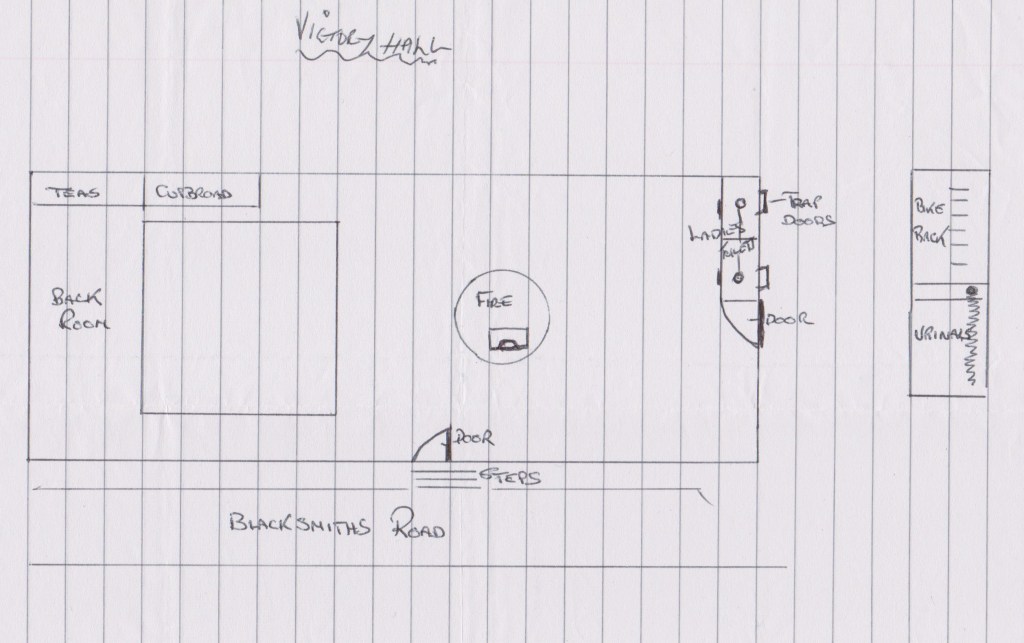
The kitchen and bar extension was built in 1994, with some major upgrades to the toilets a few years earlier.
More modern improvements include a new roof, including solar panels in 2015, and a new new ceiling in with a built in PA system a few years earlier,
 The Sheeprug Pages.