
Since it contains elements of empire, race, religion, sex, royalty, threats of violence, a woman scorned (allegedly), and unseemly behaviour (allegedly) by a Royal Marine officer, it is a little surprizing that this somewhat colourful story is not more widely known today. Had it taken place recently the tabloid press would have used it as a source of great entertainment for their readers, and it would have been cited by a wide range of social activists in support of their causes.
It was, in fact, quite widely reported in the press at the time, but since events opened in early June 1914, just before the start of WW1, and didn’t conclude until 4 months later when hostilities were well under way, most people had more pressing things to worry about. Either that or, sadly, events similar to those described here were more common than we like to think.
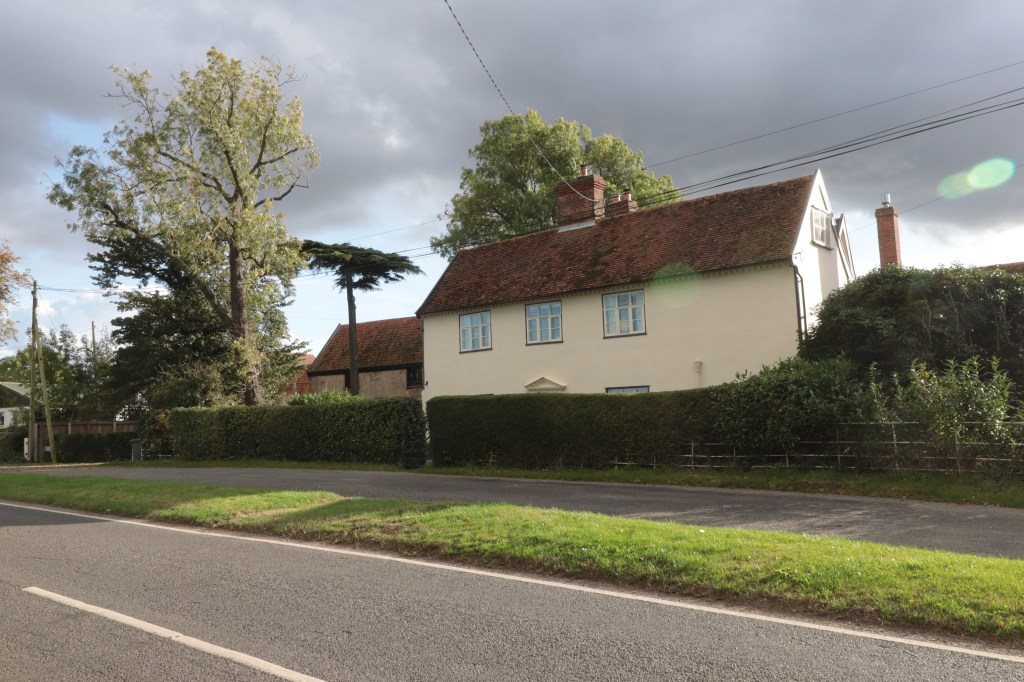
The story begins in Hasketon in early June 1914, when the concept of a major European war was far from anybody’s mind. Major William Edward Gunnel Connolly, RN Marines, after a distinguished career in which he served in Egypt and North Africa, had been taken ill and invalided home. He had recovered in hospital on the Isle of Wight, left the Marines and by 1912 had taken up residence in Hasketon Grange, a seventeenth century farmhouse adjacent to the currently popular Grange Farm Shop. He had married Ethel Harris in 1913 and the happy couple were expecting their first child. Doubtless they were looking forward to a new future living in rural Suffolk…
…and then they received a visitor.
EGYPTIAN PRINCESS’S THREATS.
Aberdeen Press and Journal – Saturday 06 June 1914
MAJOR IN FEAR OF HIS LIFE.
The Princess Seham Yousry, an Egyptian of St Luke’s Road, Bayswater, was bound over at the Woodbridge, Suffolk, Petty Sessions on Thursday for having threatened Major W. E. G. Connolly, and was the subject of a hostile demonstration. A remarkable story was told by Major Connolly.
“I knew her at Cairo,” said, “and I did not see her between 1910 and Monday last, when she came to my house in Hasketon. I asked her in Arabic what she was doing there, and she replied, ‘At last I have found you. I am your wife, and I have two children’. These statements were untrue. She attempted to shake me, and I ordered her out of the house. She replied that she would not go until she had taken my life and my wife’s. That put in fear of my life. I know what Egyptians are, so I sent my man for the police, and then, with my wife, went out of the house. The princess struck both of us with her shoe.
“When the policeman arrived she said, ‘If you have any charge to prefer against me, do so, and I will defend it.’ The policeman advised her to go away, and she did. I put in my pony to go to the police station. When I overtook her and the policeman she said, ‘I will take that man’s life.’ Later she again came to my house and attacked me with a whip. “These threats”, added the major, “were part of a series, for she had demanded money by letter from me before. In June, 1910, she wrote that she was not going back to Egypt if I did not write or telephone her. In another letter she said that £50 which I had offered her was not enough, but that if I sent her £25 she would go back to Egypt.” In answer the princess, Major Connolly said that first met her when came uninvited to his quarters in Cairo. He denied that he had any children by her, or that he married her by Egyptian law.
The princess admitted the assault, but contended that she was properly married to Major Connolly in 1907 at the Government House, Cairo, and said she had travelled to many parts of the world to find him. The decision by the bench was received with loud applause by a crowded court.’
So, it appeared a British army officer had been pursued from Egypt, across Europe, and eventually traced to Hasketon by a woman claiming not only to be his wife, but also a member of the Egyptian royal family. It’s no wonder the court was crowded!
However, the plot began to thicken a little when it became apparent that Seham Yousry had also been arrested in London a couple of weeks earlier:
“MY MOTHER WAS A PRINCESS.“
Dundee Evening Telegraph – Wednesday 20 May 1914
Young Mohammedan Woman Bound Over.
A well-dressed young woman, who claims to be the daughter of a Princess, appeared before Mr Hopkins Bow Street. She gave the name, Seham Yousry (25), and an address in St Luke’s Road, Bayswater, and was charged on remand with annoying men in the West End. A police constable who arrested her in Piccadilly Circus at midnight said that he had frequently seen her in the neighbourhood.
Another officer gave evidence as to having previously warned her as to her conduct in the street. The defendant said that she was Mohammedan, the daughter of the late Yousry Pasha, and her mother belonged to a Royal house in Abyssinia. Her father had held high judicial offices under the English Government in Egypt.
Mr. North (defending) —Is there any truth in the suggestions made against you?—No, there is not. My brother allows me a good income. My mother was a Princess, and I would not do such thing.
You are leading a proper life?— Yes; I have never done otherwise.
Mrs Alma Brook said that the defendant and her English maid had been staying at her house in St Luke’s Road, Bayswater, for about three weeks. She appeared to be highly respectable. The Magistrate bound the defendant over in her own recognisances in £20 to of good behaviour for six months.
More significantly, it later turned out that she had claimed to be married to Major Connolly in several letters written to members of his family, one of them two years earlier in 1912 to the wife of his cousin, Major Arthur Connolly.
Now it was rather frowned upon for British Army Officers to consort with local women when on service abroad, but although it happened occasionally, it was not a crime and certainly not a matter for the courts. But an accusation of bigamy was another matter altogether – and since the case had already attracted a lot of publicity, Major Connolly obviously decided he had no option but to sue her for libel. Inevitably this meant he also had to be more candid about their relationship.
The committal proceedings began the following week. I’ve made a full transcript of these proceedings, but essentially, Major Connolly admitted Seham Yousry had, ‘visited his rooms’, for a period of 2 years, but denied they were ever married, and Seham Yousry admitted she had written the letters, claiming ‘he marries a fresh girl wherever he goes”. She was committed for trial with bail set at £25.
The trial was delayed until the following month to allow papers to be obtained from Egypt, and then further delayed until September.
[During the intervening time, Gavrilo Princip was to assassinate Austro-Hungarian Duke Franz Ferdinand in Sarajevo on June 28, thus triggering the start of the First World War.]
The following is an edited down transcript of the report on the trial, published in the Woodbridge Reporter on September 17th 1914. It’s still a bit long, so feel free to jump to the judges summary if you want to omit the details. Alternatively, for full chapter and verse you can read the full transcript.
THE PRINCESS TRIAL
Woodbridge Reporter. 17th September 1914
At the Central Criminal Court on Wednesday, before Judge Atherley-Jones, Seham Yousry, age 25, described as an Egyptian princess, of superior appearance, and smartly attired, was charged with publishing a defamatory libel of and concerning Major William Edward Gunnell Connolly, retired, of Woodbridge. There was a second count of publishing the libel with intent to court money. A plea of justification had been put in, necessitating evidence from Egypt, and the trial had consequently been twice postponed.
In opening the case, Mr. Farleigh said the prisoner was indicted on two counts, the first of which was with writing and publishing the libel, and in the other she was indicted for publishing with intent to obtain money from Major Connolly. Major Connolly, counsel proceeded, was now on the Army retired list. Between 1901 and 1915 he was attached to the Egyptian force, being stationed at various places in the Soudan and Egypt. It was in June, 1903, that he was stationed at Cairo, where he got to know the prisoner, who remained with him as his mistress for eighteen months. It was not for the Court to judge of the morality of English officers in Egypt. The question to be decided was the effect of the letters prisoner had written to Major Connolly and to his relatives, and of the justification of the statement prisoner had pleaded that she had gone through a form of marriage with the prosecutor is Egypt, that he was the father of her children, and that he had deserted her. That was a very serious libel against Major Connolly, who was now married.
In the year 1910 prosecutor was invalided home. At that time he was suffering from paralysis, and at Port Said, where he was being carried on a stretcher, prisoner came up to him and created a disturbance before his fellow-officers and other people. In order to appease her demands prisoner was taken before a resident police magistrate, before whom she agreed to accept a sum of £50 is full settlement of all claims she might have upon Major Connolly. On his arrival in this country prosecutor was confined as an invalid to the Military Hospital, Isle of Wight. The woman followed him to England and eventually discovering where he was visited the hospital, and made a disturbance, and also sent a series of letters to him, which, although not in her hand-writing (for prisoner was unable to write in English), had been admitted by her. In one of these letters prisoner wrote:
“Connolly—I not write to you no more because you are no gentleman. You are very, very rude, and you do not telephone to me or write to me or speak to me. You think I go back to Egypt. No, never! I follow you wherever you go, and if you do not give me six pounds every month I will make it very warm for you.”
Last year prosecutor was married, and prisoner, learning where he was living, visited his house at Hasketon and renewed her former conduct, the disturbance affecting the health of Mrs. Connolly, and prisoner was in consequence charged at Woodbridge Petty Sessions and bounded over. On November 21 1912, the following letter which constituted a very serious libel was written from Oxford Terrace, Hyde Park, was received by Mrs. Connolly, wife of a cousin of the prosecutor. It was addressed to the Army and Navy Club:—
Dear Mrs. Connolly. I came a short time ago with Mrs. White, but had no opportunity of speak, to you. I have called many times at the Army and Navy club. I have also engaged private detectives. I have found particulars of Major: W. E. G. Connolly. I have £35 from my brother every ‘month and intend staying in London all my life to find Major Connolly. I go to the police court and say that my husband has left me, and soon it will be in the papers. I want him for love, not for money. I find that everywhere he goes he marries a fresh wife. I have a daughter four years old.
Counsel said that as the Major was unable to prove who wrote these letter, no proceedings were taken.
Major Connolly gave evidence, and denied that he ever went through a form of marriage with the prisoner. It was while he was stationed at Cairo that he made her acquaintance.
One night his servant name to his rooms and said a woman wanted to see him. She was the prisoner, who said she wanted to stay. This she did becoming his (prosecutor’s) mistress. He had given her sums of money. He was married in September of last year, and early this year prisoner found out where he was residing at Woodbridge. She created a disturbance, and said she would murder him and his wife. In November, 1912, prisoner wrote a letter which was received by the wife of his cousin, Major A. Connolly, at the Army and Navy Club.
At the conclusion of the Major’s evidence, an effort was made to settle the case, his Lordship remarking that an arrangement was desirable at such a time, because it would be very unfortunate and regrettable if incidents which had taken place years ago should now be laid open to public criticism. Counsel for the juries accompanied the Judge to his Lordship’s private room, but after the luncheon interval it was stated the trial would have to proceed.
Cross-examined by Mr. Bamford, Major Connolly was asked;
Did you know this woman to be a Princess ?—Major Connolly No, I did not,
Major Connolly was shown a photograph of himself, on the back of which were a number of names. He admitted that be wrote those names. Prisoner had said that these names were those of her brothers, but he did not know of them. Prisoner was his mistress for a little over two years. He never went through any form of marriage with her. She never lived in his house, but merely visited him in the evening. Council suggested that the prosecutor knew that the marriage was invalid because a marriage could not be solemnised between a Christian and a Mahommedan, but Major Connolly denied there was any truth in the allegation at all.
Prosecutor was asked concerning his relations with other women, and counsel read a long and an exceedingly passionate letter from a girl named “Roma,” which, prosecutor declared, was one of several letters prisoner had stolen from his quarters at Cairo, and she had held than over his head ever since.
Counsel: If this lady whom you are prosecuting believed she was your wife, she would he right in asking you for money? Prosecutor: Yes, if she was my wife, which she is not.
Counsel: In Egypt you know that it is often the case for a man to have more than one wife? I do not know the laws of Egypt; I have heard it said that some can have several wives and some can have no more than one.
This was the case for the prosecution, so far as the libel was concerned, and the prisoner gave evidence on her own behalf in justification. She speaks English fluently. She said her name was Seham Yousry; she was the daughter of Ismael Yousry Pasha, and her grandfather was Khedive of Abyssinia. Her mother allowed her £60 a month, and the family moved in good society. She herself being known as Princess Yousry. She first became acquainted with Major Connolly when she was 16 years of age at a house party of her own people. That was in 1905. Two years after Major Connolly asked her to live with him at his quarters. She did not consent, and the Major spoke to her about marriage. One day at his quarters in the old Observatory at Cairo, she and Major Connolly were present, as well as two witnesses and Sheik Mohammed Ali. A certificate was drawn up and signed, and from that time she believed, she was his wife. That certificate she had lost at Venice after producing it for the purpose of obtaining a passport. She had had two children by Major Connolly. While he lived with her he used to receive letters from a girl in England signed “Roma”. Major Connolly used to be very unhappy when he received those letters and was wont to say that he had a skeleton in his cupboard.
Was there any Seham Yousry other than your-self who lived with Major Connolly? – I do not know. I am Seham Yousry, and I lived with him.
Where are your children? – I left one in Cairo and one in Alexandria they are staying in the houses of friends, one of them being adopted. Her daughter, she said, was born in 1908.
Major Connolly, she thought, registered the birth. Her son was registered in Alexandria. She had not got the certificates of these births, having left that matter in the bands of her solicitor. She denied that her story was an invention, or that there was any truth in the statement that she was sent to a foundling institution, and was eventually adopted by the Yousry family. It was also untrue that she had stolen a card of invitation Sent to “Her Highness Princess Yousry,” and since then impersonated that lady.
Counsel: Have you ever called yourself Princess Shuka?- No.
Have you ever called yourself “H H Princess Yousry? – I am Princess Yousry, and a member of the Abyssinian royal family.
REBUTTING EVIDENCE.
At the close of defendant’s cross-examination two witnesses, Lady Gorst and Lady Maxwell. who were present on subpoena were called by the prosecution to offer rebutting evidence. Lady Evelyn Gorst, widow of the late Sir Eldon Gorst (who succeeded Lord Cromer as Conrad-General of Egypt), spoke of her residence in Cairo. She believed she had met Major Connolly once, but was uncertain. She had no recollection of having seen the defendant. Witness knew Yousry Pasha and his wife and his daughter.
Lady Maxell, wife of Lieutenant General Sir John Grenfell Maxwell, who commanded the force in Egypt from 1908 to 1912, said she had in never seen the defendant at her husband’s house in Cairo.
A translator of Arabic translated a document which, it was stated, had been signed and witnessed at Port Said. The document read: “I Seham Yousry confess that I have received from William Edward Gunnel Connolly the sum of fifty pounds (English) as damages, and that I have no right to claim anything further from him, Signed at the Police Court, Port Said. April 22nd, 1910.”
A solicitor’s clerk spoke to the enquiries which had been mode to discover the certificates of children registered at Cairo and Alexandria in the name of “Connolly”, but without success.
SUMMING UP.
In the course of his summing up, the Judge said that the defendant had invited the Jury to say that Major Connolly, being a married man, was in the habit of marrying a fresh woman at every military Station he visited. That was a serious libel, and it was for the jury to consider how far the accused had in her plea of justification substantiated those allegations. But it was a positive obligation on the defendant’s part to prove the material statements she had made: but strangely enough, she had produced no evidence of her marriage, nor any evidence regarding the birth of the children. Instead of that it had been shown that at Port Said she had accepted £50 and signed a document waiving all farther claims against him, which was not exactly the sort of thing a wife would be likely to do. Yet after his return to England she had pursued him with relentless severity, asking him to pay her money for her return to Egypt, pay her hotel bill, and even pay her the costs of her defence. But in none of her letters was there any suggestion that she was Major Connolly’s wife, and the Jury had to be satisfied beyond all reasonable doubt that the defendant had proved her case. and that what she had done in publishing those allegations was in the public Interest. The Jury, however, must on no account allow themselves to be swayed by feelings of sympathy for the prisoner, who, whatever compassion there might be for her, had shown herself capable of carrying out a vendetta of hatred and revenge.
Accused was found guilty, the Jury adding that the plea of justification had not been made out, and the Judge deferred sentence till Tuesday morning.
THE SENTENCE.
Proceeding to sentence the prisoner, the Judge said that everything that could be said in her favour had been said by counsel engaged for her defence. It had been a matter of considerable anxiety to him as to what punishment the Court should administer to her. The libel of which she had been guilty imputed to the prosecutor disgraceful conduct, unworthy of an officer of the British Army or an Englishman and she had persistently and relentlessly persecuted him since 1910. Further than that, she had deliberately reiterated the charge in a plea of justification, without attempting or venturing in support of it a shadow of evidence beyond her own unconfirmed story. He realised that the prisoner was a stranger to this country and she belonged to another race. But she appeared to be highly educated, and had as proper an appreciation of right sad wrong as any other of His Majesty’s subjects, so that her conduct was altogether inexcusable. Although she had not been animated by a desire to extort money, yet her conduct showed a vindictiveness amounting almost to persistent cruelty, without palliation of any land, and the least he could do was to sentence her to six months’ imprisonment in the second division, and he should make an order recommending her deportation at the expiration of her sentence. Prisoner, without uttering a word, was then taken below, escorted by two wardresses.
That wasn’t quite the end of it, since the defence was able to mount an appeal, based on miss-direction of the jury and the use of some inadmissible evidence. This was rejected at a hearing the following month. I’ve not been able to unearth any more information on Seham Yousry’s fate after this, and whether wartime had any impact on her deportation sentence.
By this time the British army was heavily involved in fighting in northern France and Flanders and needed all the experienced manpower it could get. So despite probably being rather disapproving of this scandal, the military recalled Major Connolly to the army. He was posted to the Irish recruitment office in Dublin, later joining the 9th Battalion of Dublin Fusiliers.
He died in Worthing, Sussex in 1946, aged 80.
Overall, I think we have to regard this as a very sad story. Seham Yousry clearly felt she was treated very unkindly by Major Connolly, and the fact that he was ill at the time he left Port Said cannot really excuse his behaviour. His initial attempts to play down the story do not sit well either. However, Seham Yousry was unable to substantiate any of her claims of being a member of the Abyssinian royal family, being married to Major Connolly, or having his children. Her family appeared to be wealthy and have to sufficient funds for her to travel to and live in London, and whether her motivation was honest or malicious, one has to admire her dogged determination to travel all the way to England and find him. It’s just a shame nobody seems to have given her any good advice before she left.
The happy side to the story is that Ethel Connolly gave birth to a son, Patrick Edward Geoffrey, in Woodbridge in the 3rd quarter of 1914. Patrick went on to join the RAF, rising to the rank of Wing Commander, before he was killed on July 15th 1944 in a bombing raid on Revigny.
A final postscript is that “R vs Seham Yousry (1914)” is sometimes quoted as establishing a legal precedence concerning the admission of evidence in courts in the UK and Commonwealth countries. See https://www.hearsay.org.au/is-he-lying-or-are-you/ for more details.
 The Sheeprug Pages.