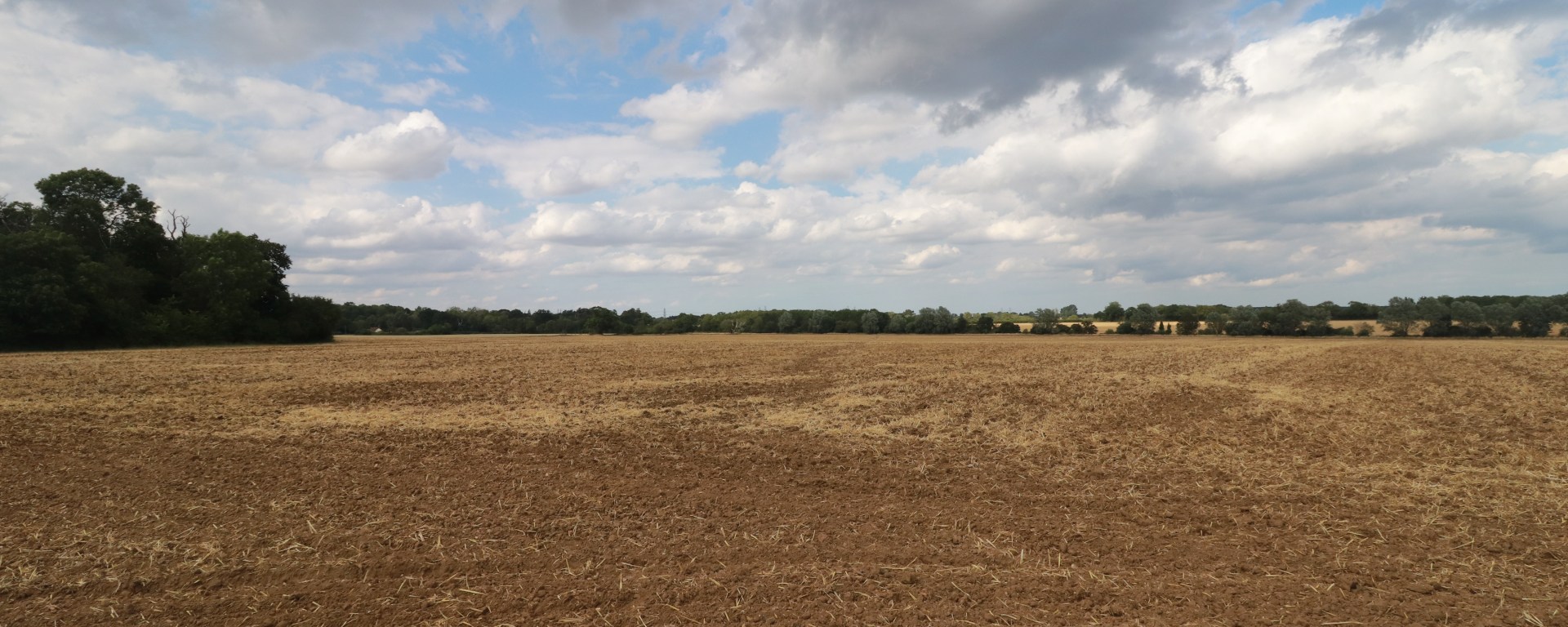
Mentioning Hasketon Racecourse to people usually engenders one of three responses: visitors, or people who arrived in the village during the last decade or two give you a rather puzzled look; those who’ve been here a bit longer, or live ‘up the hill’, respond by saying, “oh yes – isn’t that field by the side of Blacksmiths Road, at the back of Hasketon Manor called Racecourse Field”; or if they’re real locals going way back, they reminisce about going to watch them.
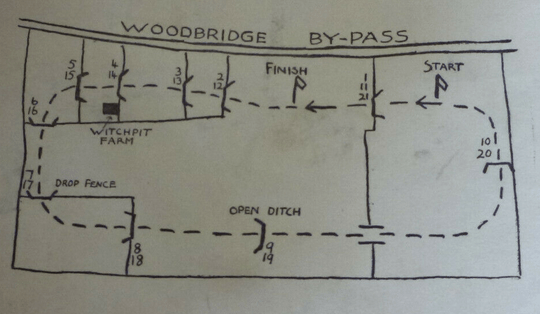
The generally agreed location for the racecourse is the fields to the west of the current A12, between Witchpit farm to the north and extending south into the fields behind Hasketon Manor. This is confrmed by the sketch map of the course from a racing programme in April 1950.
However, a few years ago we stumbled across some old press cuttings that suggested an alternative Hasketon Racecourse situated at Home Farm, in the fields nearer to the site of Boulge Hall. This was confirmed by members of the Nash family, who have lived at Home Farm for many years, and also by the Greyhound Derby website, which states:
The Initial meeting, organised by the Woodbridge Hunt, took place on Easter Monday 22nd April 1889 in the tiny village of Hasketon which can trace its history back almost to the time the Domesday Book was written. The meeting comprised a six race card staged barely 2 miles from Woodbridge on Home Farm in Hasketon, on a right handed track of a mile round with a run-in of 2 furlongs. Meetings continued to be organised annually by the Woodbridge Hunt Committee each April, with the card embracing both hurdles and steeplechases.
So it looks like Hasketon has probably had two racecourses: the earlier nineteenth century Woodbridge Hunt meetings at Home Farm, and the later one nearer to Witchpit Farm and Hasketon Manor including the field commonly known as Racecourse field. I’d love to hear from anybody who has good information and photographs about the latter course, but for the time being this is about the earlier race meetings organised at Home Farm by the Woodbridge Hunt.
The Woodbridge Hunt Steeplechases 1889 – 1907.
The Woodbridge Hunt Steeplechases had their origins in the Easter Monday Athletic Meetings, which had been held at Woodbridge during the latter half of the 19th century. The following extract from a much longer article in The Field magazine sets the scene:
“As has been the case for so many seasons past, the Easter Monday Athletic Meeting held at Woodbridge has again shown itself the premier fixture of the first bank holiday of the year. That the management of the meeting must be in really good hands it is hardly necessary to say, as year after year the sports obtain entries from the very best men at the different distances for which the races are advertised…. The space allotted to spectators all around the course was crowded as thickly as ever, but we noticed that there were not nearly so many carriages as is usually the case. The track was in capital older, affording good going both for the runners and the bicycles….
Field. Saturday 19th April 1884.
So a popular event, but there are hints that the event is beginning to struggle financially: rural East Anglia was in the midst of a serious depression in the 1880s, as farmers found it difficult to compete with the cost of grain imported from the USA and the Ukraine. The situation seems to have become critical by 1888:
I have recently heard disturbing rumours as to the Woodbridge Athletic Sports. It is whispered that the Committee are at last beginning to feel the stress of bad times, and that subscriptions are not coming in so freely as could be wished. Up to the present, everything in this direction which the Woodbridge people have taken up has been a pronounced success. Its Horse Show and its Horticultural Show have been the best in the county, and its Easter Monday athletic meeting has achieved national fame, the best athletes in the country attending to compete in the events …
The Ipswich Journal – Monday 05 March 1888.
So during the following year the organisers of the event seem to have decided that the best way of continuing athletics in the area was to change the venue to Ipswich, where the less depressed urban population might lead to larger attendances. This left an event vacuum at Woodbridge, and the Woodbridge contingent of the Athletics meeting management team with nothing left to manage.
One of the side effects of the agricultural depression was that land owners had begun to look for alternative, more profitable uses for their land. One of these was equestrian based activities, a good example of which was Colonel Frederick Barlow’s highly successful stud at The Shrubbery (now Yew Tree House) in Hasketon. Hunting with hounds was also a very popular sport in the area; e.g. the Duke of Hamilton’s Harriers at Easton. Thus a horse racing event for the area may have seemed to be a natural next step.
PROPOSED STEEPLECHASE MEETING WOODBBIDGE. On Thursday evening, a meeting was held at the Bull Hotel, Woodbridge, for purpose of arranging a Steeplechase meeting at Woodbridge on Easter Monday. Capt. R. J. Carthew presided, and there were also present: Capt. A. W. Cobbold, Dr. H. I. Kirkpatrick, Dr. G. Edwardes-Ker, Dr. J. W Green, Mr E. Branford, Mr. A. Pratt, Mr. W. M. Page, Mr. J. Smith, Mr. G. Booth, Mr. A. S. Gross, Mr. W. Brooke, Mr. A. S. Gayford, and Mr. J. H. Wrinch. After considerable discussion, it was resolved that a meeting be held, and that it be called “The first annual Woodbridge Steeplechase Meeting.” A first-class course bad been arranged, starting and ending in Bredfield Park, and those present formed themselves into a Committee for carrying out the project. Letters were read, approving the idea, from gentlemen, including Col. Barlow, Mr. Roger Kerrison, and others, and there seems every prospect of successful inauguration. Mr. G. E. Walker was appointed secretary, and it was decided to open a subscription list.
Evening star – Friday 08 March 1889
A couple of weeks later the plan was revised a little:
The Woodbridge Easter Monday Steeplechase Committee hare found it necessary to slightly alter their course, and owing to the liberality of Colonel Tomline, the stand will be erected, and the finishes take place in the Old Oak Pasture, Hasketon, which is situated within an easy walk of Woodbridge Railway Station. The view from the stand will be excellent, and sight of the grand old trees from which the pasture takes its name will alone repay a visit to the Home Farm, Hasketon.
Evening star – Monday 01 April 1889.
So we’re go for Woodbridge Races! The event was advertised in the local press, though they didn’t say where it was actually located (presumably because of the late switch in location):

The Ipswich Evening Star published the following report on the following day.
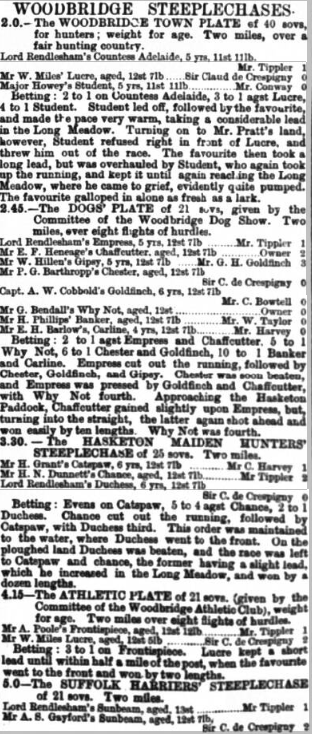
Overall, the inaugural event seems to have gone quite well, as this article from the Framlingham News describes:
The Easter Monday Athletic Meeting, which for many years made Woodbridge the centre of attraction for pleasure seekers on the first national holiday of the year, is now a thing of the past, and ” The Annual Woodbridge Hunt Steeplechase Meeting” reigns in its stead. All the enterprise that was thrown into this event in the past was transferred the race meeting, and the result was bound to be successful. The interest of Colonel Barlow and Lord Rendlesham was enlisted in the gathering, and under the guidance of gentlemen of such large experience, it was impossible to go wrong. Colonel Barlow occupied the post of Chairman to the Committee and Clerk of the course, and owing to his indefatigable exertions, the success of the meeting is mainly attributable. There were naturally many difficulties to overcome, one the most formidable being a suitable course, and we understand that, but for the extremely handsome manner in which Col. Tomline met the wishes of the Committee, the meeting would probably have been abandoned. In the most generous spirit placed at the disposal of the promoters of the meeting the Old Oak Pastures at Hasketon, which formed the base of operations, the grand stand being erected on an eminence commanding a splendid view of the adjacent country. The steeplechase course, instead being oval as was first intended, was in the form of a figure eight—starting from the Oak Pastures, round through Colonel Barlow’s meadow and the adjoining paddock, in the occupation of Mr. H. Nixon, along Hasketon long meadows, up the hill to Mr, Pratt’s farm, into Bredfield Park, and back again over much the same country. The hurdle course was entirely in the Old Oak Pastures. The meeting was held under G.N.H. rules, and all the arrangements were very satisfactory…
Framlingham Weekly News – Saturday 27 April 1889
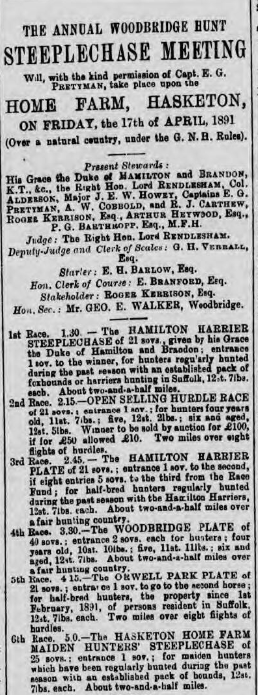
So the Woodbridge Hunt Steeplechase was established, and was to continue for the next 18 years. By 1891 the adverts were starting to look a bit sharper too:
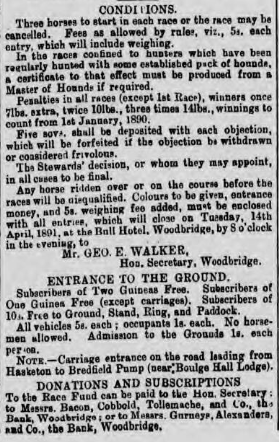
Regarding the actual location, the early accounts refer to it being held in the ‘Old Oak Pasture’ – a name that seems to have fallen into disuse. However, I think we can tie it down quite closely from the other information.
- The 1891 advert states, “The carriage entrance is on the road leading from Hasketon to Bredfield Pump (near Boulge Hall Lodge)”. Note: Boulge Hall Lodge is now called ‘Red Lodge’.
- The articles says “the grand stand being erected on an eminence commanding a splendid view of the adjacent country”. The races ran from 1889 to 1907, and the 1903 edition of the OS map of the area, shown below, shows a structure to the East of Highfield House that could well be the grandstand. It’s not on earlier or later maps, and is exactly where a grandstand would be erected to provide a view over the whole of the field to the north.
- The Steeplechase route went through Bredfield Park and Mr. Pratts Farm. At the time Ismael Pratt farmed land ‘near Foxburrow Hall’ – which probably means Foxburrow Hall Farm. The race card says the steeplechase was about 2.5 miles over open country, so we’re clearly somewhere in the Home Farm fields near Bredfield Hall.

So the most likely location is indicated in the map above. A panoramic view from the grandstand location is shown at the top of this page. As you can see, it’s an ideal location since the gentle slope means the whole of the field is easily visible.
Not everyone was happy about the event though. The Rector of Ufford was clearly not impressed in 1901:
Rector’s Protest Against the Races.—Before commencing the sermon at Ufford Church Sunday evening, the rector (Rev. H. Williams), in announcing the services for holy week, made allusion to the Woodbridge races. He said, “This week we commemorate the death of our best Friend. In all large cities and towns respect will be shown to our blessed Lord by the closing of high-class theatres, race meetings, and public amusements, and it only remains for Woodbridge, small out-landish town, to desecrate the solemnity of this holy season by holding a race meeting on Wednesday next.”
The Ipswich journal, Saturday 6th April 1901.
Neither was this journalist, reporting on court proceedings in Colchester.
The sequel to Woodbridge Races which was dealt with at Colchester Police Court yesterday produced some hard swearing, and most unprejudiced persons will be disposed to believe that the Magistrates were justified in giving credence to the story told by the railway officials. There was every reason suppose the defendant had been endeavouring to evade payment for his railway ticket, and that when the ticket inspector became insistent he should wax violent. Railway officials have good deal trouble with the crowds who attend race meetings, and they know full well that the undesirables who form a good proportion would not hesitation to defraud the Railway Company if they imagined they could do so with safety.
Evening Star, Friday 15th April 1904.
The Woodbridge Hunt continued to hold meetings until 1907. It had been able to survive the deaths of major patrons Col. Frederic Barlow and The Duke of Hamilton, who had died in 1895 and 1897 respectively, but in January 1908 the following short statement was made:
WOODBRIDGE RACES. At meeting of the Woodbridge Race Committee, at the Bull Hotel, on Tuesday evening, it was agreed, that owing to the prolonged illness of Mr. W. Bloss, one of the main supporters of the meeting, to defer the races until April, 1909.
Evening Star, Thursday 23rd January 1908.
Sadly William Bloss’s health did not improve and there was no race meeting in 1909. He died in 1910. So the last meeting turned out to have been the May 1907 event, as reported in the Sporting life on 13th May 1907.

The final end came with the sale of the remaining assets, consisting of various racing paraphernalia and a large number of wooden planks – presumably from the dismantled grandstand.

The remaining trophy was donated for a prize at the Woodbridge Horse Show later that year.
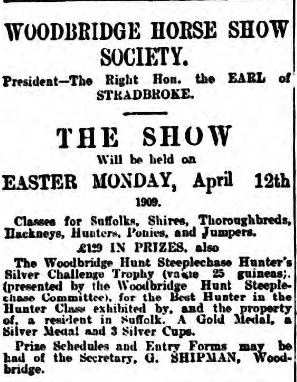
In fact that wasn’t quite the end of horseracing at Home Farm. The Hamilton Harriers, had by his time been renamed The Easton Harriers, used it on some later occasions for point-to-point meetings. However, gradualy activity moved to the fields adjacent to Witchpit Farm.
Nowadays few people seem to have heard of the Woodbridge Hunt.
 The Sheeprug Pages.
Fascinating, thanks for doing the research
LikeLike