The following is a selection of newspaper extracts which describe accidents which happened either in or near to Hasketon, or to people from Hasketon.
Scroll down or click on the links.
- Overturned double decker
- Tumbrill accident.
- Khud climbing
- Bealings bridge crash
- Swing boat fall
- Death from a horse bite
- Fall from a horse
- Falling from clover
- Laden with deals
- Fall from a cart
- Bolting horse
- Fish van driving
- Breeding accident
- Drowned in a pond
- Aeroplane-smash
- Death of a Royal Marine Officer
- Gun accident
- Broken collar-bone
- Bolting horses and waggon
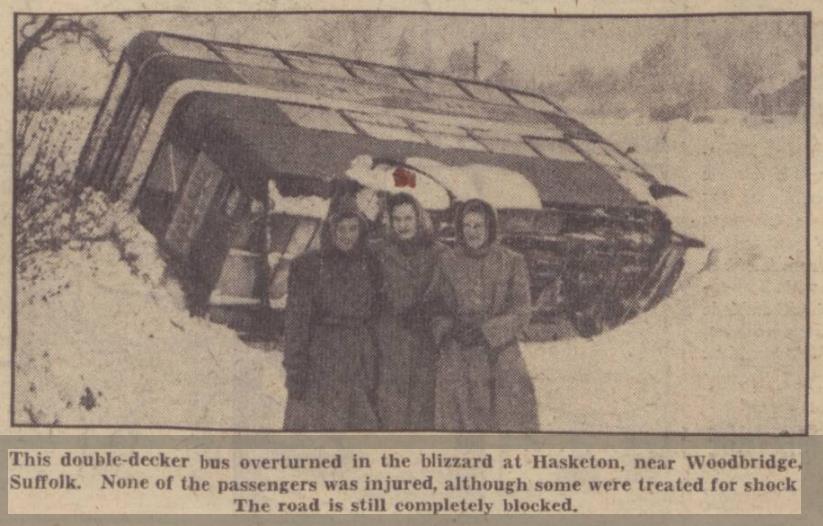
Overturned double-decker
The winter of 1951-52 was a relatively mild one until the last week of March, when south-east England exerienced one of the worst snowstorms of the 20th century. Arctic air arrived on March 27th with a series of snow storms over the next few days, peaking on the 29th with a 60mph blizzard. Some areas reported up to 10 inches of snow with substantial drifting. Much of East Anglia was paralyzed for several days. This double decker bus appears to have come to grief in Hasketon at the bottom of Catts Hill.
As soon as the records office in Ipswich re-opens we’ll see if there’s any more information on this incident In the meantime, I’d love to hear from anybody who was around at the time and can remember the incident.
Tumbril accident
The following fatal accident occured in 1909. A ‘tumbril’ was a type of two-wheeled wagon commonly used at the time for transporting sand, gravel etc., owing to it’s ability to be tipped to discharge its contents.
Labourer’s Distressing Death near Woodbridge.
A sad fatality occurred at the corner in front of the entrance to Hasketon Manor gates, at midday last Friday, when a man named James Whatling, aged 36 years, met with an untimely death. The poor fellow, who was employed Mr. Fred Smith, of Woodbridge, was in company with another man named David Hudson, engaged in carting gravel from Woodbridge to Hasketon.
At the inquest, held before Mr. Coroner Brooke, on Saturday afternoon, at the Shire Hall, Woodbridge, David Hudson, horseman, in the employ of Mr. Fred Smith, stated that he and the deceased left the gravel pit at Barrack Farm, about 12:35 p.m., with two tumbrils of gravel. While witness was going along the road past Mr. Day s brickyard, he turned around and saw the deceased walking on the near side of his horse. Just as witness had got round the corner opposite Hasketon Manor he beard the rattle of chains behind him, and on looking round observed the deceased’s tumbril turning over and the horse quite near the hedge; he was unable to see Whatling. The near wheel of the tumbril was on the bank. Witness immediately went back, and saw his mate lying face downwards in the road, about eight yards behind the tumbril, with his head towards the near side of the hedge, and his feet the middle of the road. From the position in which the deceased was lying, the witness thought that the off-side wheel had passed over his body. Witness turned the deceased over and spoke to him; did not answer, but gave one gasp. Witness then moved him to the side of the road. He had worked the horse which the deceased was using at the time of the accident, and he had always found it quiet and perfectly free from vice. The horse had never attempted to bite; it was five years old. Witness had known the deceased some time, but had never known him to have a fit. The harness was all right. There was nothing whatever to frighten the horse. Fred Whatling, farm steward, in the employ of Mr. Fred Smith, deposed that the horse the deceased was working had been bred by Mr. Smith; he gave testimony of its quietness. Deceased, who had frequently been in charge of it, was a capable horseman, and had done plenty of carting.
Dr. Wm. Redpath, of Woodbridge, who made an external examination, said the wheel of the tumbril had evidently passed over the deceased’s back obliquely from the right upwards. The spine was fractured, and also the whole of the left side of the thorax, the left arm, and the left collar bone. The injuries were quite sufficient to cause death. Witness could not remember ever attending the deceased for fits. The Jury returned verdict to the effect that the deceased died from the effects of injuries sustained through being accidentally run over by tumbril.
Framlingham Weekly News – Saturday 20 November 1909
Khud climbing.
The Rector of Hasketon Church in 1906 was Dr. John Lindsay. Three of his sons served in the military, and sadly the youngest, Charles, was killed in a climbing accident whilst serving in India. “Khud” is an indian term for a deep ravine.
OFFICER KILLED WHILE KHUD CLIMBING.
The particulars the fatal accident tint befell Second Lieutenant Lindsay, attached to the 1st Cameronians, at Chakrata, the 16th July, have reached Hasketon. The official statement of Corporal J Murchison, 1st Cameronians, follows:- “On July, 1906, Second lieutenant Lindsay took the company out Khud climbing. We started towards Deoban Hill, and after we had gone about half-way up he halted the Company. After about five minutes, he fell the Company in, and started going down the Khud on the left hand side of the road. It was very steep indeed, and the grass was very slippery. The Khud just there slopes steeply for about 200 yards, amongst big boulders, and then drops sheer for about 300 feet.
When we started going down Mr. Lindsay was in front, Sergt. Cuthbert next, and I next. After we had gone down about 150 or 200 feet. Sergt. Cuthbert shouted, “Help, help! Mr. Lindsay has gone over the Khud.’’ I heard something slip and fall, and thought was big stone, until Cuthbert shouted.
“There were three men with me, and we tried get down, but it was too slippery, and we had to turn back. We went away the left a bit, and met the remainder the Company coming across, above where Mr. Lindsay fell.
“I told them what had happened, and asked them if I could get down on the left; they said that there was no way down at all. I then went to the top and saw Sergt. Simpson and got five men from him, and told him to send barracks for a dhoolie. I then told the five men to come down with me. I managed to get to the watercourse to the right of where Mr. Lindsay fell. “When I got to the bottom, I sent two men hill the opposite aide, and told them to see if they could see him on the face the Khud. I heard a dog barking up the Khud, and thought perhaps he might there. I went as far as I could, but could see nothing. The men who went on the other side saw E Company, and reported to Second-Lieutenant Riddell-Webster. He came down with two men, and went away along the bottom of the Khud. I came down the Khud, and was going after them when I found Mr. Lindsay’s body amongst the rocks. I called Mr. Webster back, and as we stood there his dog fell beside us from above, and broke its legs, and had to be destroyed. We took Mr. Lindsey’s body back to the barracks.
Charles Colin Christie Lindsay was the youngest the three sons of the Rev. John Lindsay, Rector of Hasketon. The eldest, Lieutenant and Assistant-Adjutant Napier Burnett Lindsay, is in the 1st Royal Irish Fusiliers, and the second son, Mr. John Maitland Lindsay is in Siam; both these went through the Boer War, the former with his Regiment, and the latter being then a Lieutenant in the 4th Battalion of the Norfolk Regiment, with the mounted Infantry of the Essex and Norfolk Regiments.
Evening Star – Wednesday 08 August 1906
Bealings bridge crash
Breaking a thigh bone aged 70 is obviously very serious, but I gather Mr. Smith was made of stern stuff and survived to live on for another decade.
SERIOUS TRAP ACCIDENT NEAR BEALINGS.
A HASKETON GENTLEMAN SEVERELY INJURED. The very many agricultural and other friends of Mr. Joseph Smith, of Thorpe Hall, Hasketon, will learn with regret of the serious accident which befell him on Wednesday evening. It appears that Mr. Smith’s groom drove to Bealings Station to meet his master, who arrived by the train reaching Bealings at about seven pm, and on proceeding homeward the trap, which had no lamps alight, collided with the bridge about 200 yards from the Railway Station. One side of the trap was smashed, and both Mr. Smith and the groom were thrown out; the latter escaped with a few slight bruises, but Mr. Smith, it was found, was much injured. Assistance was quickly procured, and Mr. Smith’s own phaeton was sent for, in which he was afterwards conveyed to his residence. Dr. Hollis, of Woodbridge, was summoned, but that gentleman not being at home, the services of Dr. Henley were procured, who found Mr. Smith had sustained a fractured thigh, besides being severely cut about the face and bruised. Mr. Smith is over 70 years of age, and at the meeting of the Woodbridge Board of Guardians (of which body Mr. Smith is a vice-chairmen) on Thursday morning the news of his sad accident was received with much concern.
The Ipswich Journal – Saturday 06 October 1894
Swinging boat fall
Accident. —On Monday evening at the fair on the Market Hill a young woman named Vyce, of Hasketon, who was in a swinging boat, overbalanced and fell out. She was picked up unconscious and removed the Seckford Dispensary where she is under the medical care of Dr. Hollis, her shoulder being dislocated in two places.
The Ipswich Journal – Saturday 05 April 1902
Death from a horse bite
I suspect that incidents like this, before antibiotics were available, were not uncommon.
HASKETON. DEATH FROM THE BITE OF A HORSE.
An inquest was held at Burgh, on Thursday evening, Mr. W. Brooke, Deputy Coroner, touching the death of William Mallett, Hasketon, labourer, aged 40 years. Deceased was in the employment of Mr. Harry Reynolds, farmer, and was in the stable with his master about a month ago. Mr. Reynolds went to a horse’s head to back him, when deceased remarked, “Mind he don’t bite you; he has just nipped me on the wrist”. Last Friday week deceased complained of pain in his left side, and Dr. Kerr attended him on the Sunday evening following. He was then apparently suffering from bronchitis, and he appeared to recover. On the following Tuesday he complained of pain in his right wrist. He got no better, and expired on Wednesday. Dr. Kerr stated be was sent for to attend deceased on the 7th inst, and found him apparently suffering from bronchitis. He prescribed for deceased, who subsequently recovered. On the following Tuesday deceased complained of his right wrist, and stated that about a month previous a horse had bitten his wrist. There was, when he saw deceased on the first occasion, only a slight bruise on the wrist joint. This injury caused acute inflammation, and necrosis, or death of the bone, from which he died. Deceased told him he bad been accustomed to work the horse, and he did not in any way complain of any vice. — The Jury returned a verdict “That deceased died from the effects of accidental bite of a horse.”
Framlingham Weekly News – Saturday 20 May 1893
Fall from a horse
Col. Haines moved into Hasketon Manor in 1892. (We know this because we can read an account of his housewarming party). I can’t find any records to indicate whether his coachman James Totman survived this nasty fall.
HASKETON – FALL FROM A HORSE.
A very serious accident happened to James Totman, Col. Haines’ coachman, on Wednesday. He left the Manor Farm on horseback to go to the Woodbridge Railway Station; when going round the corner against the Manor House Lodge the horse stumbled, and Totman was thrown and fell on his head. Several people came up and found him unconscious. Mr. Ablitt, driving a lady and gentleman to the Colonel’s at once drove back to Woodbridge for Dr. Hollis, who promptly attended, and the injured man was sent to Woodbridge and placed in the Dorothy Ward at the Seckford Dispensary, and everything possible was done for the sufferer by Dr. Hollis and Miss Horns (the nurse).
The Ipswich Journal – Saturday 20 August 1892
Falling from clover
Poor little girl!
HASKETON. ACCIDENT-On Friday morning, as Mr. David Shimmen’s little girl was riding on a load of clover, she fell over with great force to the ground. Dr .Edwardes Kerr was sent for, and upon his arrival found she had sustained a fracture of the collar bone.
The Ipswich Journal – Friday 28 September 1888.
Laden with deals
From the description it seems likely the cart in following incident was travelling along the current B.1079 road and came to grief somewhere near Thorpe Hall. In this context, a ‘deal’ is a softwood plank.
GRUNDISBURGH. DEATH FROM UPSETTING OF A CART.
An inquest was held yesterday (Monday) afternoon, by C. C. Brooke, Esq., coroner, to enquire into the death of William Smith, labourer, aged 33 years. Deceased was last seen alive near the Shoulder of Mutton Cottages, in the parish of Hasketon that morning, with a cart laden with deals, and was riding in the body of the cart between the deals, and the cart was then swaying from one side of the road to the other. Shortly afterwards Frederick Clark, of Grundisburgh, was going up the hill past Mr. Smith’s, of Hasketon, and saw deceased lying in the road and the cart turned upside down, and deceased under it, with the horse lying on his back and three deals resting on the head of the deceased. The deals were all securely tied on the cart and did not appear to have moved, there were prints of a wheel on the bank on the near side of the road, the wheel appearing to have gone up the bank about a foot and a half, caused by the swaying of the heavy weight on the cart. Deceased was quite dead. Verdict, accidental death.
The Ipswich Journal – Tuesday 22 June 1875
Fall from a cart
This sounds horrible. There’s no further information available to determine whether Mr. Manning survived, but there is a James Manning [B. Dallinghoo, 1840] living in Woodbridge in 1881.
HASKETON. ACCIDENT.
On Friday, the 21st inst., a serious accident occurred to a labouring man, named James Manning, who worked for Mr. Joseph Smith, farmer, Hasketon. The men were carting rye grass, and Manning, who was on the top of the load when it was being drawn into the barn, when all of a sudden he came head foremost on the asphalt barn floor. It is supposed he tried to avoid coming in contact with the beam at the entrance of the barn, and in so doing rolled off the load. Dr. Steggall, of Grundisburgh, was immediately sent for, also Mr. Hughes, surgeon, Woodbridge who found the poor man in an insensible state, and bleeding profusely from his mouth and ears. His skull is smashed and the body much bruised: he is still lying in a very precarious state, and unconscious.
The Ipswich Journal – Saturday 29 June 1872
Bolting horse
This incident probably involved Cordelia Barlow, wife of horse breeder Frederick Barlow who lived at the Shrubbery (now Yew Tree House) in Shrubbery Lane.
On the following day, a pony and chaise, driven by Mrs. Barlow, of Hasketon, were coming over the Market Hill, when the pony suddenly started off at a furious pace down Church Street; at the bottom of the street it ran into the window of Mr. Mills’s shop, throwing out the occupants of the chaise, who happily received no injury beyond the severe shock. The pony dashed away again down the Quay Lane, and was stopped by a man named Blowers, but not until it had injured itself very seriously. No cause is assigned for its bolting, as it has always been considered very quiet and docile.
The Ipswich Journal – Saturday 26 November 1870
Fish van driving
This is not specifically about Hasketon, but I like it. I can’t help feeling that if BMWs been available in 1838, this driver would probably have driven one.
FISH VAN DRIVING.
On Sunday evening a fish-van, heavily laden, was driven at a most rapid rate into Melton. From the great weight of the machine and the velocity it had acquired in descending the hill, the horses became unmanageable, and it ran with full force against one of the shop windows of Mr. Capon, general shopkeeper, forcing in the shutters and windows, and damaging goods to the amount of £10. After a change of horses, the driver started again and within a mile or two of the place of the first accident, going of course at full speed, in order make the lost time, the vehicle came contact with and upset a gig with lights, in which were two persons, who were thrown out, but luckily not hurt, but the horse they were driving received so much injury as to be unable proceed. Thus, within a few miles a considerable destruction of property takes place, the lives of the public endangered, and the security and comfort of travelling put to a stop to during the season, by the proprietors of fish vans employing inexperienced men as drivers, who for their incivility, carelessness, and cruelty, are alike notorious. In order to put a stop to the nuisance we can confidently state, should a conviction take place, the Magistrates will inflict heaviest fine the law allows.
The Suffolk Chronicle; Saturday 08 September 1838.
Breeding accident
(From the Annual Meeting of the East Suffolk Agricultural Society held in Wickham Market.)
On the ground was exhibited a lasus naturae of an extraordinary character — namely, three hybrid animals between a Southdown sheep and a deer. These singular creatures were bred by accident in Glemham Park, and are, or were, the property of Mr. Bates. In the carcass, they are like the Southdown, but the head is destitute of wool, and singularly discoloured. The legs are also destitute of wool, and particularly in the foot part, are shaped like those of the deer. These curious creatures attracted the attention of all the sheep fanciers.
Bury and Norwich Post – Wednesday 16 September 1840
Drowned in a pond
A reminder from 200 years ago that ponds are dangerous, though it seems a little harsh on poor Hannah Pizzy to go down in posterity as a lunatic as well. The Liberty of St. Ethelred was a religious court having juristriction over the Hundreds of Carlford, Colneis, Loes, Plomesgate, Thredling, and Wilford
On Thursday an inquisition was held by John Wood, Gent. Coroner for the Liberty of St. Ethelred, view of the body of Hannah Pizzy, aged 13, who was found drowned in a pond at Hasketon, near Woodbridge, the day before. Verdict – Lunacy.
The Suffolk Chronicle. Saturday 08 February 1812
Aeroplane smash at Gull Farm.
During WW1 this little corner of Suffolk became an area for aeronautical research, with airfields at Orford Ness, Butley and of course, Martlesham Heath. This activity continued after the war with the inevitable accidents:

The plane was a De Havilland DH.10A Amiens IIIA, a twin engined bomber developed towards the end of WW1. More details of the incident can be found on the Bureau of Aircraft Accidents website.
Death of a Royal Marine officer.
DEATH OF LIEUT. HENRY FREELAND.- We regret to record the death of Lieutenant Henry Freeland Royal Marines (son of the late Rev. Henry Freeland, Rector of Hasketon, Suffolk, and nephew of C. G. Round, Esq., and the Rev. J. T. Round, of Colchester), on board the Royal George. one of our fleet in the Baltic. A letter from an officer on board the Duke of Wellington flag ship gives the following particulars of the painful occurrence :-” A most melancholy accident happened on board the Royal George. Mr. Freeland, lieutenant Royal Marines, had been subject to fits, and on the night of the 24th he had one, and endeavoured to get out of bed, but in doing so he fell out, and his legs were kept in his bed by the clothes being tightly tucked in, so that his head hung down, and he was stifled. His servant found him quite dead in the morning. He was a most worthy and religious young man, and stood high in the esteem of all who knew him. He was buried with great honour on shore. About 1,500 men attended the obsequies.”
The Ipswich Journal – Saturday 13 May 1854
Gun accident
One hopes Mr. Ling gave Frederick ample help after this nasty incident. In the 1871 census Frederick Johnson is living in Charsfield, employed as an agricultural labourer, with wife Mary and 3 children, the oldest 2 being born in Hasketon. So it looks like he made a good recovery.
WOODBRIDGE. Gun Accident at Hasketon. A few days ago, Frederick Johnson, a labourer, while firing a gun at crows on Mr. Ling’s wheat field, received a severe wound in the left hand from the bursting of the gun. Several grains of shot also entered Johnson’s eyes. The shot has been skilfully abstracted by Mr. H. Moore, of Woodbridge, surgeon; but the sufferer will for some considerable time be unable to work. He has a wife and child to support, and has always been an industrious, well behaved young man.
The Suffolk Chronicle; or Weekly General Advertiser & County Express. – Saturday 27 April 1867
Broken collar-bone
WOODBRIDGE Accidents. A little boy, about five years old, named Frank Sawyer, son of Mr. John Sawyer, dealer, had his right collar bone broken on Thursday afternoon. The little fellow, with other of his schoolmates, had just left the infant school and went into the Clothes Factory yard opposite. Mr. Whalley, the superintendent, went to put them out of the yard, and a horse and cart, belonging to Mr. Lyon, of Hasketon, coming past at the time. Sawyer fell down and the wheel passed over his shoulder. Mr. Whalley was also knocked down by the wheel.
Framlingham Weekly News – Saturday 01 March 1873
Mrs. Sawyer, the mother, in her haste to fetch the doctor, ran against post and received a contusion of the left eye, which is blackened.
The little boy is under the care of Mr. Moore, surgeon, and is doing well. There was no fault to be found with any party.
Bolting horses and waggon
Aside from the serious injuries to Mr. Lanham, this must have been a very dangerous incident. Market Hill was very much the centre of Woodbridge at the time, and there would probably have been a lot of people about. Suffolks are big horses, and the waggon would have been quite heavy, even if it was unladen.
On Saturday morning, about 9 0’clock, a waggon and a pair of Suffolk horses belonging to Lieut. Colonel R Eaton-White of Boulge Hall, were proceeding to Woodbridge in charge of Boaz Lanham, of Looms Farm, Burgh. When near Farlingay Hall, Woodbridge, the horses were frightened by the whir of an aeroplane, and bolted. Lanham, who was walking by the side of the horses, endeavoured to stop them, but was knocked down, the wheels of the wagon passing over his body. The horses dashed down the Burkitt Road and onto the Market Hill, where they ran into the Bull Hotel, smashing the window and breaking the shafts off the waggon. Lanham was conveyed on the town ambulance to the Police Station by Mr. Charles cutting, assisted by PC. King, where he was examined by Dr. Brebner who found he had sustained severe internal injuries. The poor fellow was later conveyed to the East Suffolk hospital in a military ambulance.
Woodbridge Reporter, 21st March 1918.
 The Sheeprug Pages.