
No. 50557 Service Corps, previously in either the Sussex or Royal West Kent Regiment.
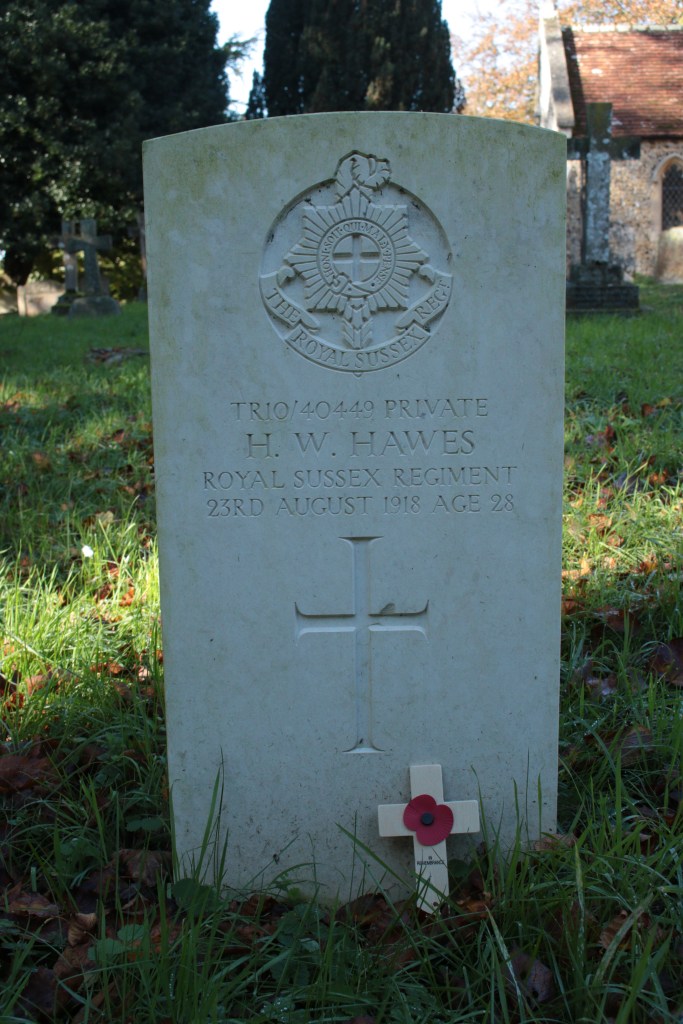
Henry died on 23rd August 1918 aged 28 and is buried in Hasketon Churchyard.

Henry was born Grundisburgh September 1890, son of Walter and the late Ellen Jane Hawes of Gull Cottage, Hasketon. He died at Home from natural causes (heart failure).
We can’t find Henry in the 1911 census, so his occupation in the years prior to the war is unknown.
Personal details
Parents were Walter Hawes [B. Otley,c 1862] and Ellen Hawes nee Groom [B.Grundisburgh, c1862].
Henry is their 5th child, the others being Cecilia [B. Grundisburgh, 1886], Ellen [B. Grundisburgh 1889], Charles [B. Hasketon 1895], Walter [B. Hasketon, 1898], Arthur [B. Hasketon, 1900]. They are living in Hasketon in 1901 where Walter is working as a ‘Horse man on farm’
Ellen does not appear in the 1911 census when Walter and the rest of the family, with two further children, Leonard [B. Hasketon, 1900] and ( Alberta) Cora [B. Hasketon, 1902], are living at Coppings Farm, Helmingstone. Walter is now a farm bailiff.
Henry lived in Hasketon until at least 1901, but does not appear in the 1911 census when he would have been 20 or 21. Presumably he has left home and has not been registered elsewhere, or may have joined the army.
There is a death registered for Ellen Jane Hawes in 1912.
Walter is listed as next of kin in the Army register of soldiers’ effects. Henry is the older brother of Charles Francis Hawes, and cousin of Albert Hawes – see separate entries.
War service.
There is contradictory information regarding Henry’s military service: The Commonwealth War Graves Commission record him as TR10/40449, 51st Battalion Royal Sussex Regiment, transferred to (505575) 692nd Agricultural Coy. Labour Corps.
However, in the War Office list of Soldiers Who Died in the Great War he is listed as: Private, 505575, Labour Corps, Formerly 13256, R.W. Kent Regiment.
Unfortunately, we can’t find Henry in either the Royal Sussex or West Kent Regiments, and there’s no Medal Roll Index Card we can confidently relate to him. We therefore suspect there has been a clerical error or miss-transcription at some point. Note that soldiers were often transferred to the Labour Corps if they were not physically fit enough for front line service due to injury, wounds or ill-health. Records made at the time were often incomplete, so confusion over the soldiers previous regiments and numbers are common.
The Labour Corps was a large organization of unarmed soldiers performing a wide variety of support activities both overseas and, increasingly as the war went on, in industry and agriculture at home in the UK. Henry’s Death Certificate, shown below, indicates he died from heart failure whilst working as an agricultural labourer at Bawdsey in Suffolk.

 The Sheeprug Pages.