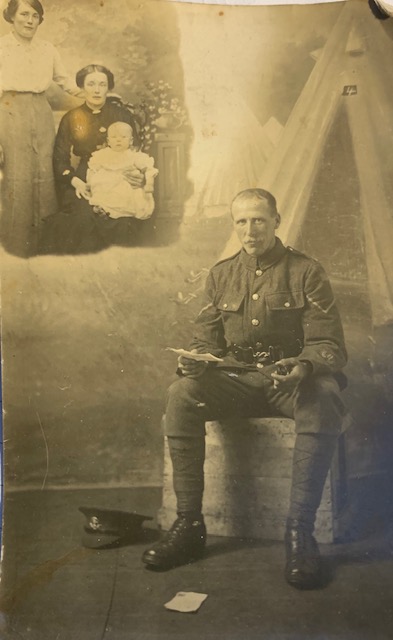
No. 3367, Royal Fusiliers and No. 34489, 6th Battalion Duke of Cornwall’s Light Infantry, who died on 2nd may 1917, aged 31.
He died of wounds in hospital in Rouen, possibly sustained at the 1st Battle of the Scarpe (Battle of Arras) 1917, and is buried in St. Sever Cemetery Extension, Rouen, France.


William was born Grundisburgh in 1884, son of Alfred and Charlotte Quinton, was married to Ellen and had 4 children, Dorothy, William, Alfred and George.
Before the war he worked as a “Cow man on a farm”.
Personal details
Frederick’s parents were farm labourer Alfred Quinton [B. Grundisburgh 1861] and Charlotte Quinton (nee Last) [B. Grundisburgh 1864]. He was the oldest of 10 children, the others being: Ernest George [1885], Charlotte Ellen [1886], James [1887], Alfred Thomas [1889] Harriet [1892], Violet Kate [1894], Arthur [1896], Leslie Walter [1903] and Frank Edward [1905]. All were born in Grundisburgh.
In 1909 Frederick married Ellen Hilda Sawyer [B. Martlesham, 1886]. The 1911 census shows them living in Great Bealings and had a daughter Dorothy Ellen Harriet [1910]. They had 3 more children: William (Jun 1911), Alfred [B. June 1912] and George [B. Sept 1913]. The army list refers to him as a Hasketon resident when he enlisted, so presumably he moved here after 1911.
After the war, Ellen married George William Osborne in 1921 and had two more children, Leonard [B. March 1922] and Frederick James [B. Sept. 1923].
In 1931 his daughter Dorothy married Edgar Bucket, and according to the 1939 register they were living in Top Road, Hasketon.
Frederick is also remembered on the Grundisburgh memorial.
War service.
In common with many WW1 servicemen, most of Frederick’s war records have been lost: all we have is the information in the official list, “Soldiers Who died in the Great War 1914-1919”. From this we can see he was initially in the Royal Regiment of Fusiliers (No.3367), but later at an unknown date moved to the 6th Battalion of the Duke of Cornwall’s Light Infantry (No. 34489). We also have his Army Medal Rolls Index Card, which show Frederick was awarded the Victory and British medals, but not the 14 or 15 Star medals. This indicates he arrived in France after December 1915.
Frederick died of wounds in the military hospital in Rouen on 2nd May 1917. No details are available, but since the 6th Battalion Duke of Cornwall’s Light Infantry (DOCLI) was heavily involved in the 1917 Battle of Arras, and in particular the First Battle of the Scarp (April 9th – 12th, 1917), it’s possible he sustained his injuries then.
The Royal Cornwall Museum website has some more information about the Duke of Cornwall’s Light Infantry in WW1.
During the war there were several camps and hospitals based in the outskirts of Rouen. Soldiers who died in the hospitals were buried in a number of different locations including the main Rouen city cemetery at St. Server. Since that time Rouen has expanded, so the cemetary is now in a rather pleasant suburb of the city. Quite a lot of the graves in the cemetery extension are in pairs. It’s not clear why this was done, or if Frederick knew Lance Corporal Metcalfe prior to their deaths on the same day.

The Quinton family suffered greviously during WW1. Fredericks younger brother Alfred was in the 2nd Btn, Suffolk Regiment and was killed on 2nd March 1916 during an attack on the German trenches near Ypres. Later on 9th August 1917, Fredericks brother James, 7th Btn. Suffolk Regiment, was killed during a raid on the German trenches near Arras.
Unveiling the Village Memorial.
Fredericks wife Ellen and two of their two children, Dorothy and Alfred, were at the dedication of the Hasketon War Memorial in December 1919, and the children also had the responsibility of performing the unveiling. A photograph of the event is shown below.
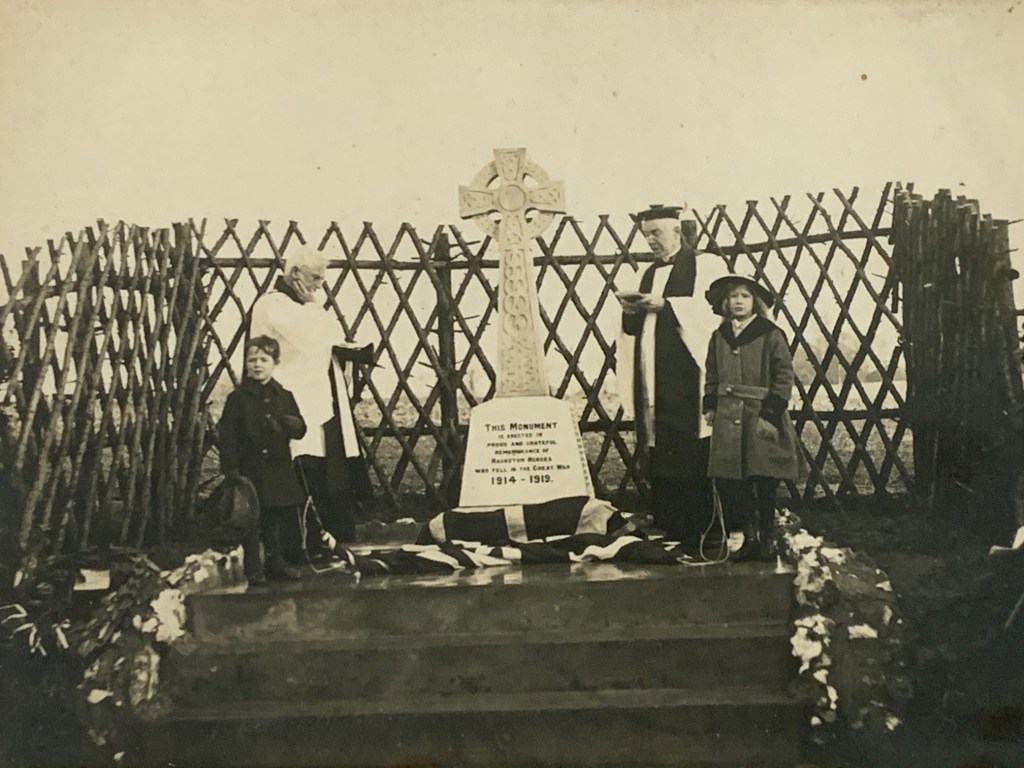
….The unveiling and dedication service was conducted by the Rev. Canon Laurence who was assisted by the Rector (Rev. F W Wait). A brief address was given by Canon Laurence, based on the text, “Two men shall be in the field, one shall be taken and the other left” (St. Luke xvii, 36).
Extract from the Woodbridge Reporter, 11th December 1919.
A procession was led from the church by members of the Memorial Committee, the choir, clergy and Boy Scout, followed by the congregation, included in which were a number of soldiers in uniform, the processional hymn being, “Brief life is here our portion”.
As the procession formed in front of the memorial the sun burst out in splendour. The actual unveiling was done by Dorothy and Alfred Quinton, the fatherless children of a soldier who had lost his life in the War.
 The Sheeprug Pages.