No. 12754 9th Battalion Essex Regiment, who died on 18th October 1916 aged 26.
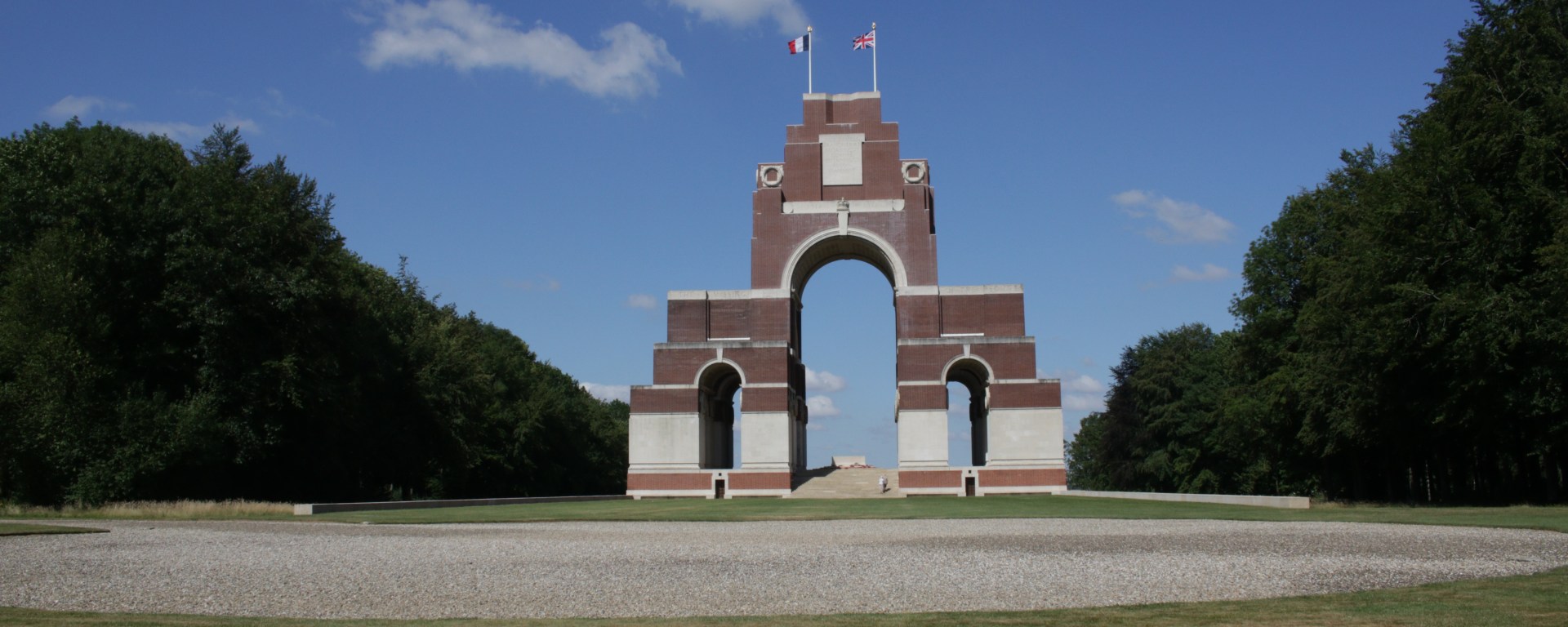
Frank has no known grave and is remembered at Thiepval Memorial.
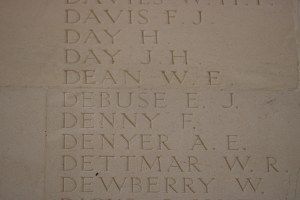
Frank’s inscription on the Thiepval Memorial
He was born in Helmingham in 1890, son of Edgar and Ellen Denny, and later lived at the Red Lodge Hasketon.
He died during the Battle of the Somme whilst fighting at Le Transloy.
Before the war he worked as a Gamekeeper.
Personal details
See also entry on Frank’s brother David Denny.
Father Edgar Denny was born in Ashbocking in 1859 and worked as an agricultural labourer and his mother was Ellen Annie Denny (nee Ruffles) [B. Chelmondiston, 1860]. Frank [B. Helmingham 1891] was their 4th child out of 10, the others being James [B. Otley, 1882], Walter [B. Helmingham, 1885] Thomas [B. Helmingham, 1889] Hilda [B. Helmingham, 1893], David [B. Helmingham, 1895], Frederick [B. Helmingham,1897] Ellen [B. Hoo, 1899] twins Madeline and Noel [B. Hasketon, 1902] This suggests sometime in the late 1890s they left Helmingham, moved to Hoo, and then finally to Hasketon in about 1902.
In 1911 Frank was boarding in Gt. Braxted, Essex, working as a gamekeeper, presumably at Great Braxted Hall. In 1915 he married Elizabeth Carter in Chelmsford. She is noted as his next of kin in his war records, and received his personal effects.
Frank is also remembered on the Great Braxted and Moulsham War Memorial, in Chelmsford.
War service.
Frank joined the Essex Regiment at Chelmsford and served in the 9th Battalion. According to the Medal Roll index he entered France on 24th August 1915, and thus qualifies for the British, victory and 15 Star medals.
The 9th Battalion was involved in a number of significant battles after his arrival in France, and Frank may have been all the following actions: the Battle of Loos (October 1915), Hohenzollern Craters (March 1916), attacks on Ovillers-la-Boisselle and Poziers (July 1916). Franks’s death on 18th October 1916 indicates he was killed in the later stages of the Battle of the Somme during the Battle of Le Transloy. On this day the 9th Battalion of the Essex Regiment took part in an attack on a German trench referred to as Bayonet Trench. The weather had been appalling, rain turning the ground into a swamp, and they found the barbed wire had not been effectively cut. Little progress was made and the men were compelled to return to their starting trenches after suffering heavy casualties.
Frank’s Victory Medal.

 The Sheeprug Pages.