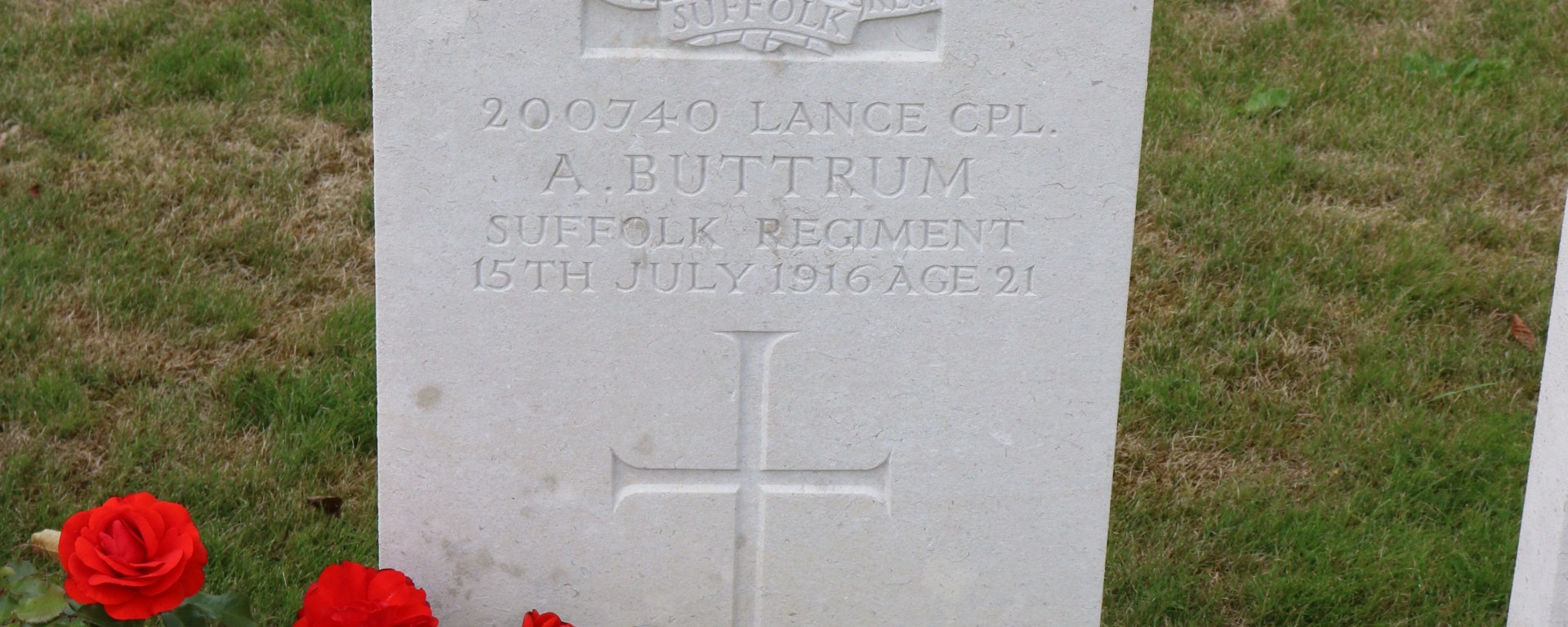
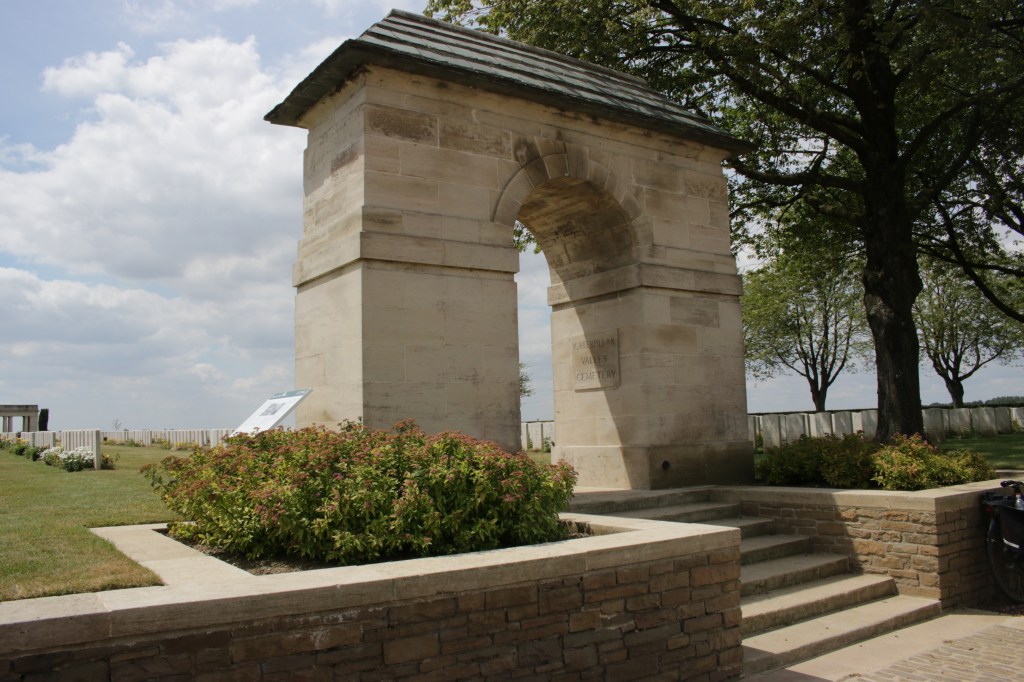
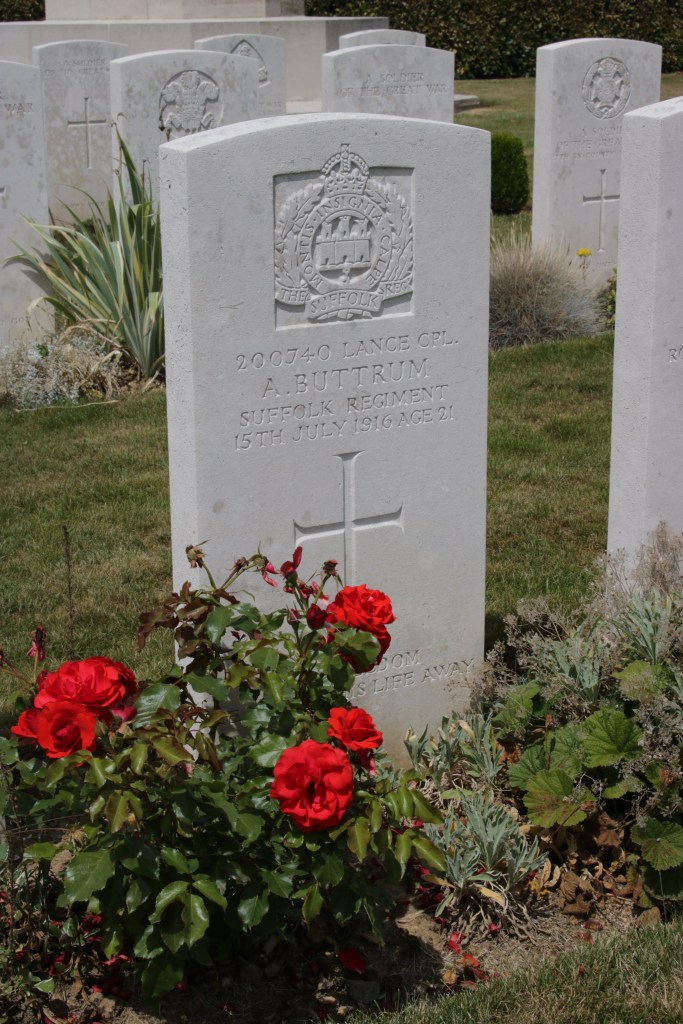
Aaron is remembered at Caterpillar Valley Cemetery, Longueval.
No. 200740, 4th Battalion Suffolk Regiment, who died on 15th July 1916 aged 21.
Aaron was born in Hasketon 1895, son of Aaron and Mary Jane Buttrum.
He died during the Battle of the Somme whilst fighting at Bazentin Ridge.
Before the war he worked as a Groom.
Personal details
(Note we had a little difficulty in untangling this story. I think we’ve got it right, but let me know if you have more information.)
Aaron was born in Hasketon, his parents being carpenter Aaron Buttrum [B.Hasketon, 1834] and Mary Jane Buttrum (nee Nunn), [B. 1865, Thorpe Suffolk]. The family address in the 1901 Census is Burgh Road. The Commonwealth War Graves commission in 1918 have his mother’s address as ‘Pightle’, Hasketon. (This means a small field or enclosure.) The location is unclear but may have been near Lowood, where the 1939 Register records 4 Pightles, or possibly in Top Road. His father was first married to Margaret (Nee Rumens), and they had 6 children before her death in December 1888 aged 53. In September 1889 Aaron (senior) entered into an ultimately unsuccessful 2nd marriage with Martha Taylor in Sudbury district.
At about the same time, single mum Mary Jane Nunn [B. Thorpe, Suffolk, 1864] was struggling financially. In the 1891 census she is recorded, along with her two daughters, Gertrude [B. Nacton,1891] and Louisa [B. Nacton, 1890], as living in Woodbridge Union House, Nacton. She became Aaron (senior’s) housekeeper sometime in the early 1890s and they had 4 children together over the next few years: Ernest [B. Hasketon 1894], Aaron [B. Hasketon 1895], Wilfred [B. Hasketon 1897] and Milly [B. Hasketon 1899]. In 1896 the 3 eldest children were baptized in St. Andrews Church, Hasketon, and the vicar comments on this unconventional arrangement in the Baptism Register. In the 1901 census these children are all given the surname ‘Nunn’. In December 1905 following the death of his 2nd wife Martha in September 1905, Aaron (senior) and Mary finally marry and their children are given the surname Buttrum in the 1911 census. Aaron (senior) died in late 1916, aged 82.
Post-war in 1921 Mary and son Wilfred continued living in Hasketon where their address is given as ‘The Pightle’. We believe this to be in Top Road. Later on in the 1939 Register, Mary Jane Buttrum is recorded as living in Manor Cottage, Little Bealings. Her son, Wilfred, is also living with her and is a ‘Private Gardener’. Ernest is a poultry farmer in Brockford, Suffolk with his wife Mabel.
War service.
In common with many WW1 soldiers, Aaron’s Army Service Records are not available, so we cannot identify the date he enlisted in the Suffolk Regiment. Along with many of the Hasketon men he joined the 4th Battlion which, at the time, was a territorial battalion. The Medal Roll Index indicated Aaron entered France in March 1915, and was awarded for the British, Victory and 15 Star medals.
He may have taken part in several actions with the 4th Battalion during 1915/16 including the battles of St. Julian, Aubers Ridge and Neuve Chapelle.
His death on 15th July 1916 indicates he was killed when the 4th Battalion of the Suffolk Regiment supported the 1st Battalion of the Middlesex Regiment in an unsuccessful attack on German trenches near Bazentin-le-Petit during the Battle of Bazentin Ridge – part of the wider Battle of the Somme. The 4th Battalion suffered over 200 casualties on that day. See separate page for further details on Hasketon men at the Battle of the Somme.
Also of interest.
Aaron’s older brother Ernest Edward Buttrum also joined the army, enlisting on 2nd September 1914 and joining the Suffolk Yeomanry (No. 320098). Later in 1917 the Yeomanry became the 15th Battalion Suffolk Regiment. In October 1916 the battalion was posted to Egypt and fought several actions in the Eastern Mediterranean. Some of his Service Records have survived. Ernest seems to have suffered severely from ill health throughout 1918, with a severe bout of diarrhoea whilst abroad, followed by malaria whilst on home leave in Ipswich (presumably also contracted abroad), and he was then caught up in the Spanish flu epidemic in November 1918.
 The Sheeprug Pages.