
As is well recorded, the first day of July 1916 was a terrible day for the British Army, a day that saw over 60,000 casualties, including 20000 dead, and very little gained. As far as we can determine, there was just one Hasketon resident involved in the first day of the Battle of the Somme. Charles Wells Wait, eldest son of the then Vicar at Hasketon, Frederick Wait, was a Lieutenant in the 10th Battalion of the Kings Own Yorkshire Light infantry (KOYLI). On that day his battalion took part in an attack on German trenches near the village of Fricourt. They made important gains early in the day and held off a German counter attack in the afternoon, but were ordered to consolidate their position later in the day without having gained their objectives. Charles survived that attack, but sadly his battalion suffered almost 400 casualties and moved out of the front line to reorganise.
Two weeks later on July 14th the British army launched a second major offensive which became known as the Battle of Bazentin Ridge. Unlike the opening day of the battle, where the attack was preceded by many days of artillery bombardment on the German lines and the troops attacked well after dawn, this attack started during the night and was preceded by only a very short bombardment. The starting lines are shown in red in the map below, and the day’s objective in green.

The result of this change in tactics was total surprize with most of the German front line trenches taken before dawn and nearly all of the first day’s objectives achieved and exceeded in some cases as shown by the blue line. This included the capture of the villages of Bazentin-le-Petit and Bazentin-le-Grande along with some, but critically not all of the associated woodlands. In particular, the strategically dominating High Wood remained partially in German hands and was to be fought over for many weeks to come.
On the following day the decision was taken to continue the attack in the direction of Martinpuich. This turned out to be a serious tactical error because during the night the Germans had counter-attacked and re-taken most of High Wood where their machine guns could dominate all the area to the south and west.
Many of Hasketon’s volunteers were in the 4th Battalion of the Suffolk Regiment which was scheduled to take part the attack on July 15th. Early in the morning, after bivouacking overnight, the Battalion was sent out to support the 1st Battalion of the Middlesex Regiment in an attack on the German trenches just north of Bazentin-le-Petit in the field to the right of the road to Martinpuich. Unfortunately, the attack failed as troops came up against heavy artillery and machine gun fire from both the German ‘Switch Trench’ in front of them and from High Wood from the rear/side. The 1st Queens Battalion attacking to their right were a little more successful, but still were unable to achieve their objectives. Photographs 1 and 2 show the location of the attack, taken in July 2018. Note that this picture would have looked very different in 1916 – the location had been between the German defensive lines for over a year, so the fields are unlikely to have been in crop and the whole area would have been significantly militarized.
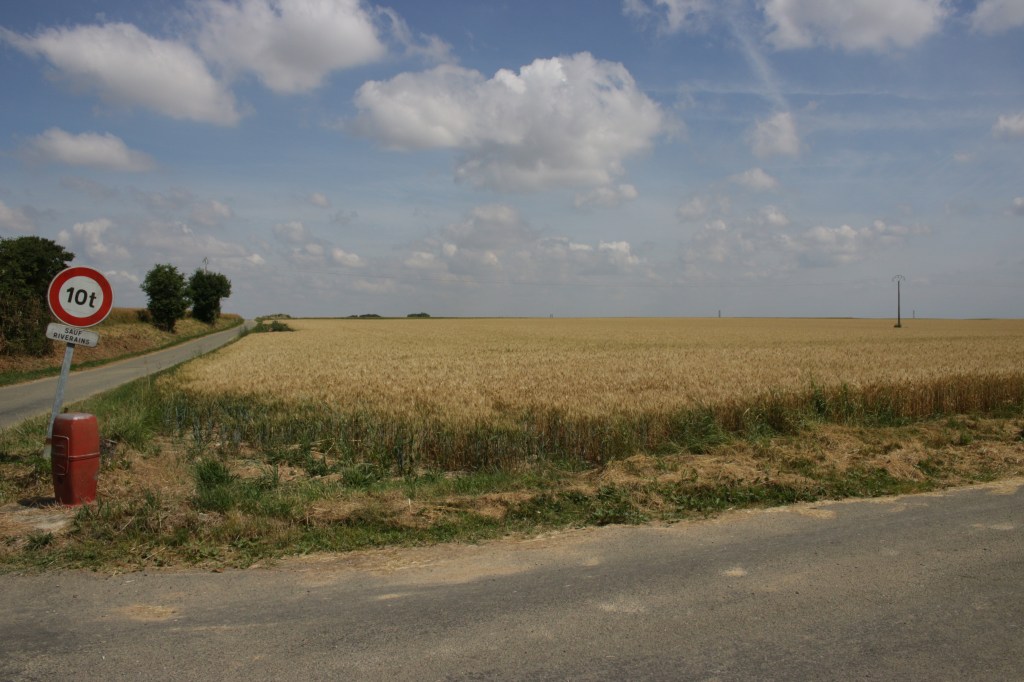

The Suffolk 4th battalion sustained over 200 casualties (28 killed, 157 wounded, 17 missing), including 3 Hasketon residents who lost their lives: Aaron Buttrum, Charles Groves and Archibald Wright. The 4th Battalion War Diary records:
July 15th, 6:00am. “The Batn. Moved to support the 1st Middlesex Regt. In attack on SWITCH Trench. A & B Coy. Formed the first line and C and D the second. A line immediately in front of the village of Bazentin-le-Petitwas eventually taken up and the line held throughout the day.
The casualties in the Battalion were heavy…
The battalion moved out of the lines for a day, only to return to the front line in Bazentin le Petit on July 17th.
This more detailed explanation comes from the 1st Middlesex Battalion website.
At 3 a.m. the next morning the Brigade was again ordered to attack, and the 1st Middlesex (Lieut.-Colonel H. Lloyd) set out at about 6.30 a.m. for Bazentin-le-Petit, from which village the assault of the enemy’s position was to be made. The advance was made through a gas cloud, which made everyone feel most uncomfortable, though apparently none of the troops were actually “gassed.” On reaching the church at Bazentin-le-Petit, “B” and “C” Companies worked round the northern side of the village, whilst “A” and “D” Companies went straight through it. Just beyond the eastern edge of the village there was a road running north and south*; here the Companies deployed for the attack. “B” and “D” formed the front line, with “C” and “A” in support. The Battalion attacked on a frontage of 800 yards. The 1st Queen’s of the 100th Brigade (33rd Division) were on the right of the Middlesex, and 2nd Welch Regiment (1st Division) was on the left. Supporting the 1st Middlesex of the 98th Brigade were the 1/4th Suffolks, while the 2nd Argyll and Sutherland Highlanders and the 4th King’s Regiment were in reserve.
The first objective allotted to the Battalion was the German Switch Trench.
The Battalion had scarcely deployed for action when a party of the enemy in the Northern corner of Bazentin Le Petit Wood fired into the left flank of the advancing Middlesex men, with machine gun and rifle. Moreover, the enemy sent up red and white flares, and soon the hostile field guns and howitzers had placed a heavy barrage on the line of advance. Machine-gun fire “principally (from) High Wood, which we had been informed was in our possession,” (From the Battalion Diary, 1st Middlesex) now began to take heavy toll of the advancing Companies, which were finally brought to a standstill on the crest of a slight ridge east of the village. Shelled unmercifully and machine-gunned from both flanks, the gallant Middlesex, attempting to “dig in” on the position gained, were eventually compelled to fall back to the road running north and south on the eastern outskirts of Bazentin-le-Petit from which they had started. The flanking units apparently fared no better, and the Suffolks, in support of the 1st Middlesex, were likewise brought to a standstill.
Charles Wells Wait’s 10th Battalion Kings Own Yorkshire Light Infantry was still in the area, and also moved into the front line in Bazentin le Petit village later on July 15th. Their positions were subjected to some very heavy shelling at this time, during which Charles Wells Wait was wounded and died later in the day. This brought the number of Hasketon residents killed that day to 4.
After the attack on July 15th it became apparent that the German defences in High Wood dominated the area and it had to be taken before further progress could be made. During the next few weeks many attempts were made to capture it.
A few days later on July 20th the Suffolk Regiment 4th Battalion went into action again, this time supporting the 19th Brigade in an attack on High Wood. The attack was made from Bazentin le Petit through the fields to the west of the village and into the wood itself. The location for this attack is shown in Photograph 3.
The 4th Battalion War Diary records:
July 20th. At 7.00am instructions were received to move to a position in the vicinity of the Cemetary in support of the 19th Inf. Bde. In an attack on High Wood and a German trench N. of the same. D. Coy. was first sent forward, the remaining Coys taking shelter and digging in. D Coy, with the 2nd Argylls attempted to take a German strong point, but this effort was held up by heavy M.G. fire and the Coy returned to await darkness. At about 4.30 pm, A & B Coys, under Lt. BROWN, were sent forward but they were also compelled to retire.
Casualties were again heavy (15 killed, 82 wounded, 20 missing), and 4 more Hasketon residents lost their lives: David Denny, Stanley Morris Thompson, Walter Thompson and Charles Blake.
Thus in less than a week 8 Hasketon men had been killed.
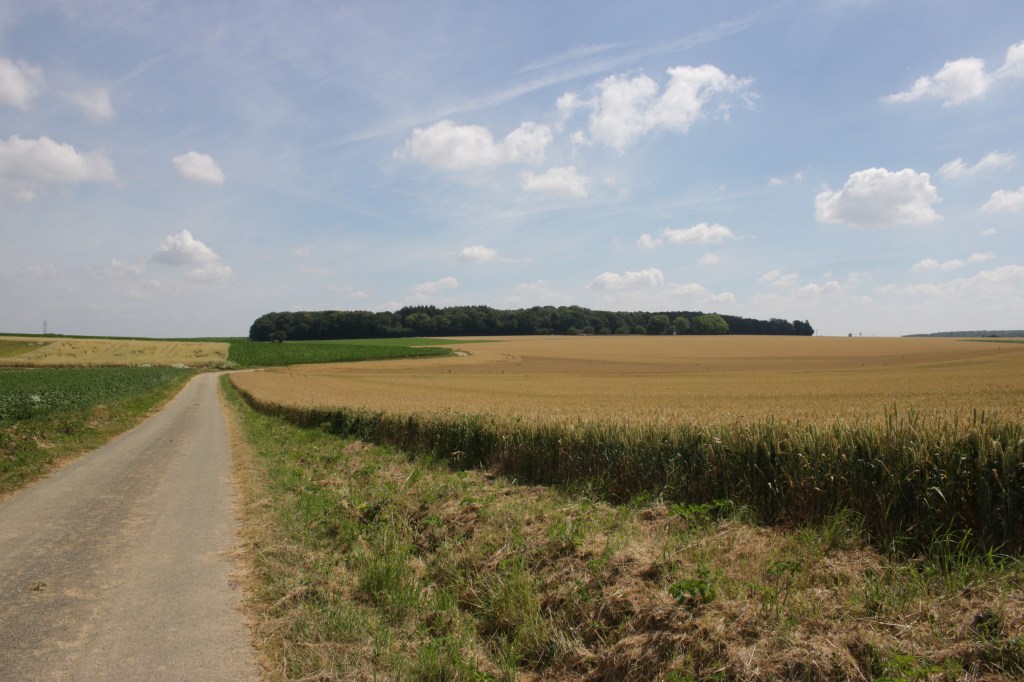
The ground around High Wood was fought over heavily for the next month, with enormous numbers of British and German troops being killed. There are accounts of bodies literally becoming part of the defensive earthworks in many cases. By the middle of August British troops held over half of the wood but German strongpoints on both the Eastern and Northern corners proved to be extraordinarily tough. Eventually the British Army resorted to mining under the German trenches, the result being little progress and a massive crater in the wood that is now a gloomy weed filled pond under the trees.
On August 15th the 4th Suffolk Battalion again went in to the trenches, this time just to the East of the Wood. After a few days working on the trenches they mounted and attack on August 18th along with the 4th Battalion Kings Liverpool Regiment and Argyle and Southerland Regiment. They were the only attacking unit to gain their objectives which left their positions untenable and they were obliged to return to their starting trench with nothing to show for their efforts. Their casualties on this day were 33 killed, 108 Wounded and 23 missing. Private William Adams was amongst those killed.
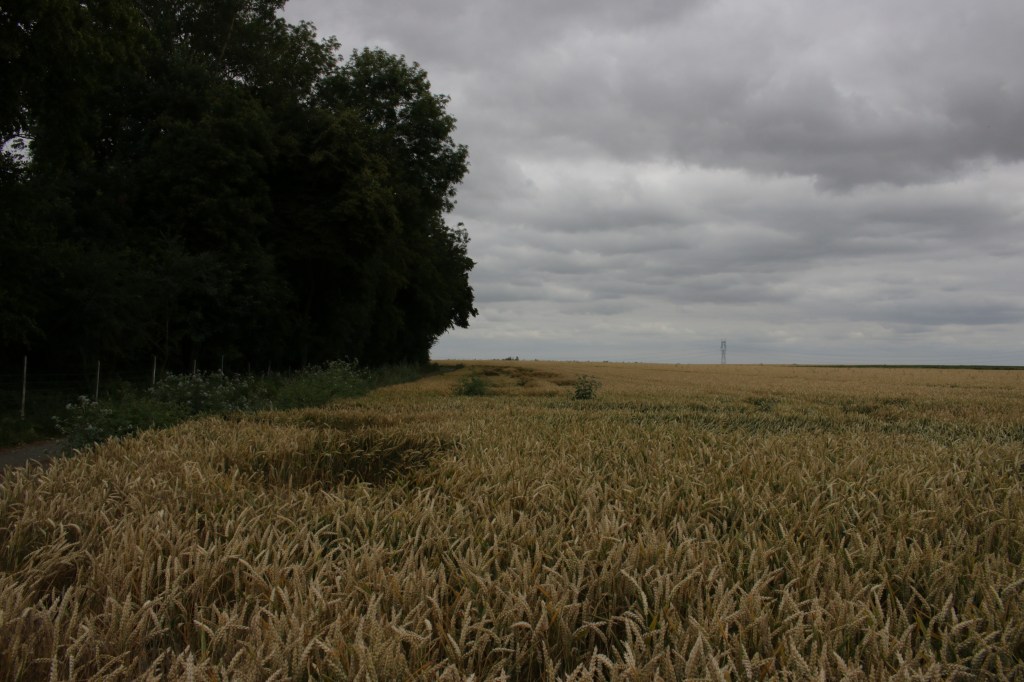
Photograph 4. The field to on the eastern side of High Wood through which the 4th Battalion of the Suffolk Regiment attacked on August 18th 1916.

Photograph 5. A view down Wood Lane towards Longuval from the East corner of High Wood. This would have been no-mans-land on August 18th 1916.
Eventually High Wood was captured in its entirety on September 15th during a major British offensive that became known as the Battle of Flers-Courcelette, notable as being the first battle in which tanks were used.
The following month on October 1st the 4th Army launched its last major action of 1916, with a new offensive in the direction of the village of Le Transloy. It was an attack dogged by appalling weather with persistent rain turned the ground into a swamp and fog prevented aircraft from flying. On 18th October the 9th Battalion of the Essex Regiment took part in an attack on a German trench referred to as Bayonet Trench. Little progress was made owing to the weather barbed wire not being effectively cut, and the men were compelled to return to their starting trenches. Private Frank Denny was killed during this action.
Later on during November the Army Generals decided to re-visit some of the northern areas of the Somme battlefield where they had suffered such heavily casualties on July 1st. This became known as the Battle of the Ancre. (The Ancre is a tributary to the main Somme river). The 4th Canadian division took part in this action, with the 50th Battalion attacking German trenches near the village of Grandcourt, just north-east of Courcelette on November 18th. Private Eric Victor Pollard was found to be missing after this action and was declared missing presumed killed on the following day.
The Battle of the Ancre was the final British Offensive of 1916 and marked the end of the Battle of the Somme. During the 4 and a half months of the campaign the allied forces had advanced roughly 6 miles into German occupied territory. The cost in men’s lives was enormous: estimates vary, but figures are in the region of 623,000 casualties (146,000 killed) for the Allied armies, and 465,000 to 600,000 (165,000 killed) for the German Army.
Hasketon lost 11 men during the Somme campaign, only two of whom, Aaron Buttrum and Charles Wells Wait, have known graves.
.
 The Sheeprug Pages.