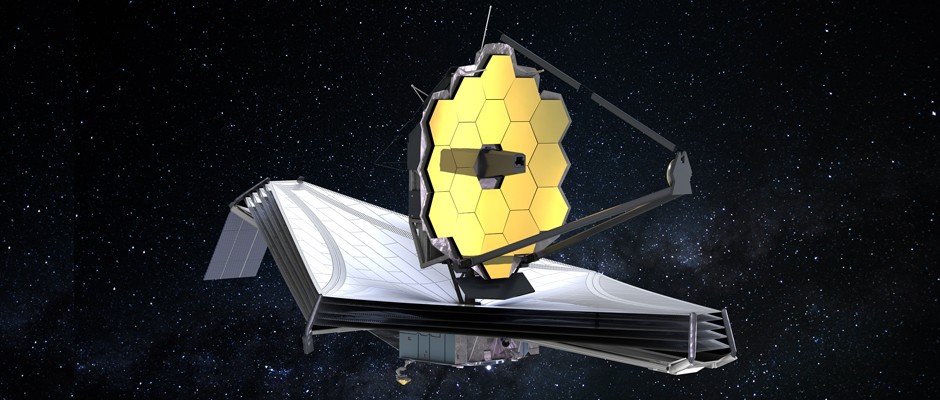
With all the excitement about OMICRON and Christmas going on, we seem to be overlooking an exciting event which was originally planned for 2007, then 2010, 2016, and now is finally scheduled to happen tomorrow, Christmas Day 2021 at 12:20 UK time. Yes, it’s the launch of the James Webb Space Telescope (JWST)!
Intended as a successor to the Hubble Space Telescope (HST), the JWST is bigger, more complex, more expensive, has incredible performance at infra-red wavelengths, and is going to revolutionise our knowledge of the universe… or that’s what the sales blurb says anyway. It’s certainly an impressive bit of kit – read all about it here:
https://en.wikipedia.org/wiki/James_Webb_Space_Telescope
or here:
But here’s the thing, do you remember how much trouble they had with the Hubble Space Telescope when it was first launched? Basically, NASA made one of the most spectacular and embarrassing engineering cock-ups in the history of cock-ups when they ground the telescope mirror the wrong shape. To be fair it was only slightly the wrong shape, caused by a missplaced washer in the testing jig, but the effect was to render the whole multi-billion dollar project useless until they developed a set of ‘spectacles’ about a year later. This transformed it into a rather brilliant project. A great recovery, you might say!
But the JWST is not only much more complicated, but the way it is designed to work means it CANNOT be modified after launch. Its operating location will be at what’s known as the earths 2nd Lagrange point, 1.5 million kilometres away, way too far for a maintenance mission. And because it’s so big (the heat shield alone has 5 layers and is the size of a tennis court, and the main mirror is 6.5m across) it has to be folded so it will fit inside the Ariane rocket launcher.
So what is supposed to happen is after launch it gradually makes its way to the operating location, unfolding heat shields, solar panels, telescope mirror supports, and the main mirror itself, in stages as it goes. But will it? I know it’s been tested as far as it can be tested, and NASA has had several more recent successes under its belt, but I can’t help feeling there’s simply far too much to go wrong.
But obviously, I really want it to succeed, because if it works as planned it will be brilliant.
Fingers crossed!
 The Sheeprug Pages.